Processes
Warehouse Receipt
In SIEVERS WMS, a distinction is made between several types of warehouse receipt:
Possible are
- document-oriented warehouse receipts and
- physical warehouse receipts (MDE).
These are further divided into
- One-step warehouse receipts and
- Two-step warehouse receipts.
Perform a one-step document-oriented warehouse receipt
As soon as an inbound delivery has been notified, you can start creating a warehouse receipt in SIEVERS WMS. This section describes how to perform a one-step Warehouse Receipt Process.
Hinweis
In order to be able to carry out a warehouse receipt, an source document must exist, such as a purchase order or sales return orders.
First create a new Warehouse Receipt Process on the Warehouse Receipt page. Alternatively, you can also create a warehouse receipt directly from a purchase order and skip steps 2-4. To do this, select Create warehouse receipt in the start menu.
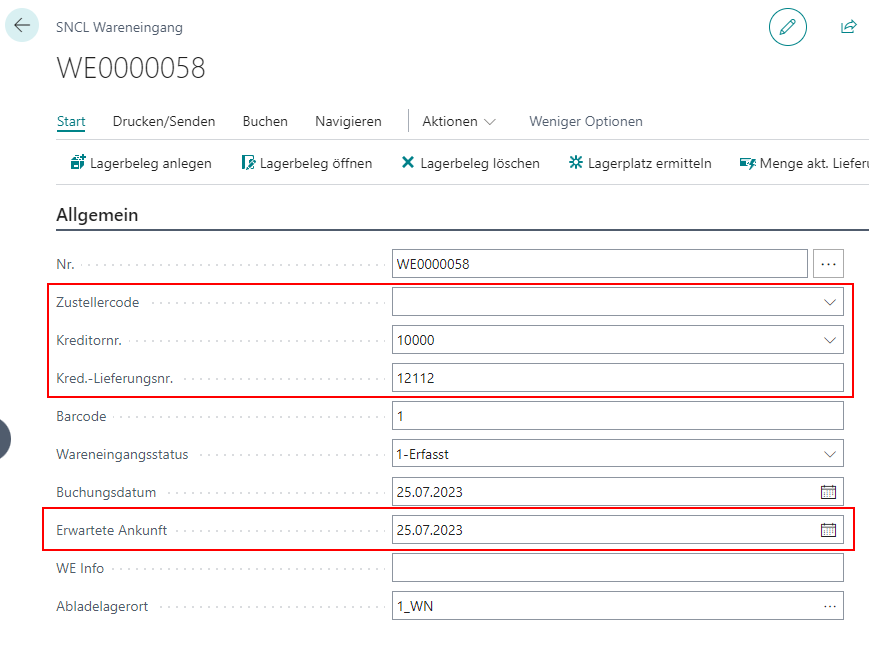
The following fields must then be filled in the warehouse receipt:
- Shipping Agent Code or Vendor No.
- Vendor Shipment No. with the delivery note no.
- Expected arrival
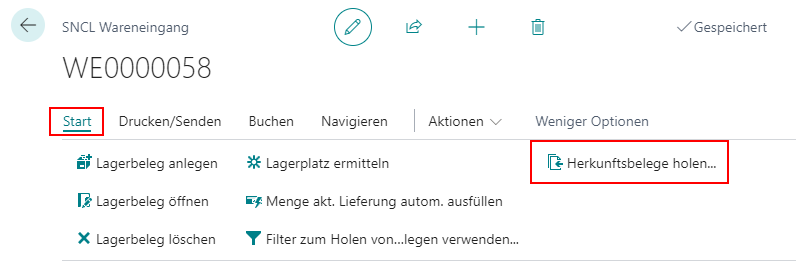
- You can now assign a purchase order to this warehouse receipt via Start -> Get source documents. Alternatively, you can also manually enter several shipment notes in the [document lines](#receipt entry) of the warehouse receipt. In this case, the document numbers of the shipment notes are entered first.

If it is a notified warehouse receipt, you can now set the warehouse receipt status to 0-Notified.
At the latest when the shipment has arrived, the Number of load carriers field in the Warehouse Receipt Header must be filled.
Items can also be marked separately with item labels at this point if required. To do this, select Print item label via the "Line" menu of the document lines after selecting the item.

- The document lines in the Qty. to Receive field are now filled with the quantity actually received and the line is accepted by clicking on Quantity checked. Load carrier lines are created according to the packaging hierarchy. If no packaging hierarchy exists for this item, as many pallets are created as are specified in the Number of load carriers field and the Qty. to Receive is distributed across them. In addition, the Inventory measure code is automatically set to the Inventory measure code picking set in the SIEVERS WMS setup. The system checks whether the allocation of receipt lines to load carriers is plausible. If the number of load carriers in the receipt lines is not equal to the number in the allocated load carriers, the number is highlighted in red and a message is displayed. The new storage place code in the load carrier lines is generated using the Inbound Stock Post strategy. You can adjust this if necessary.
Hinweis
Please make sure that no Warehouse Receipt Strategy is stored in the SIEVERS WMS setup or that the Warehouse Receipt Strategy is configured so that it does not lead to an unloading place. Otherwise, the unloading place at the Warehouse Receipt Header is automatically filled and the warehouse receipt becomes a two-stage warehouse receipt.
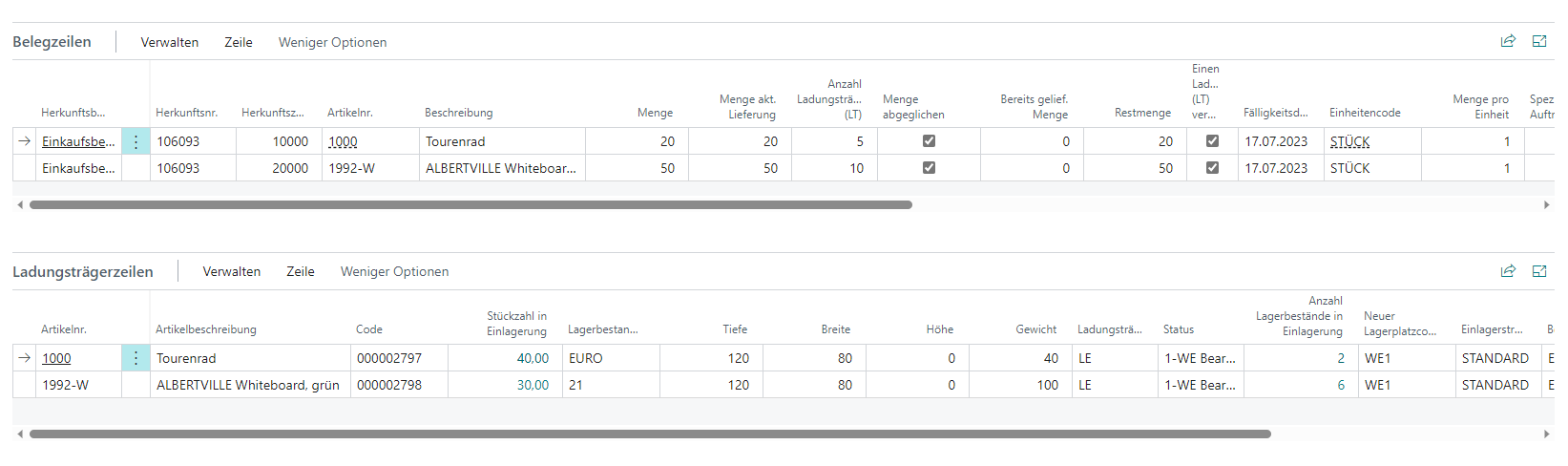
- for a better overview, a supplier package reference can be entered in the Label comment text field. This comment text is printed on the package and enables the warehouse receipt employee to identify the individual package more quickly.

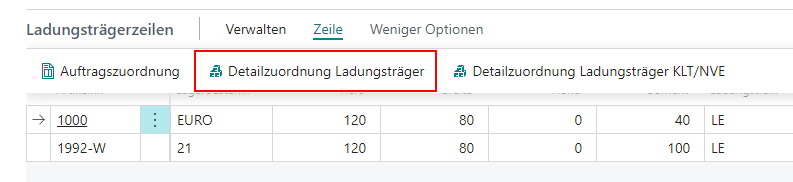
- if necessary, you can edit the assigned load carriers in detail in the [Load carrier lines](#container lines) area. The Detailed assignment of load carriers can also help here. You can use this to post different items to a load carrier, change the quantity assignment and create a print lead for the labels of all load carriers and items.
- now print the load carrier labels and attach them to the pallets. This will ensure that the pallets can be clearly identified in subsequent processes.

- The shipment can then be accepted with a forklift, for example. Here, the shipment note is marked by an employee in warehouse receipt with a copy of a blanco barcode. The original barcode can be given to the forklift driver, who marks the corresponding shipment or pallet. The barcode is then entered in the corresponding field of the warehouse receipt.
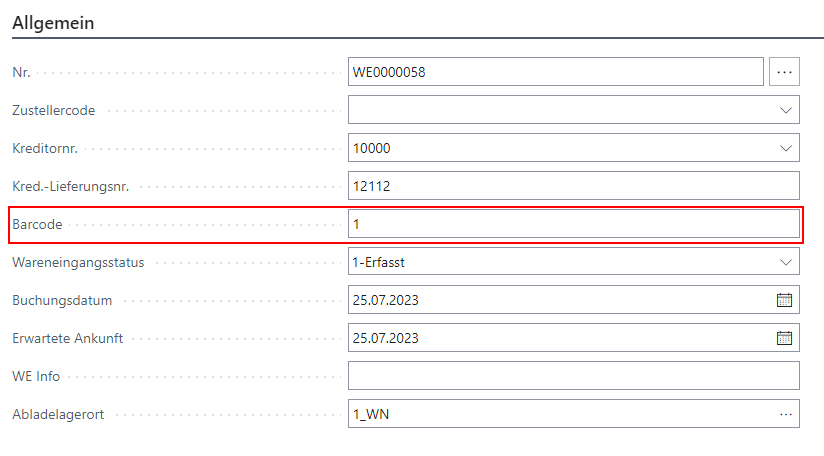
- you can now post the warehouse receipt. The prerequisite for this is that the setting Completion of warehouse receipt is set to After commercial check.
Perform a 2-step document-oriented warehouse receipt
As soon as an inbound delivery has been notified, you can start creating a warehouse receipt in SIEVERS WMS. This section describes how to carry out the Warehouse Receipt Process.
Hinweis
In order to be able to carry out a warehouse receipt, a source document must exist, such as a purchase order or sales return orders. In addition, a Warehouse Receipt Strategy must exist that routes warehouse receipts to the unloading places.
first create a new Warehouse Receipt Process on the Warehouse Receipt page. Alternatively, you can also create a warehouse receipt directly from a purchase order and skip steps 2-4. To do this, select Create warehouse receipt in the start menu.
the following fields must then be filled in the warehouse receipt:
- Shipping Agent Code or Vendor No.
- Vendor Shipment No. with the delivery note no.
- Expected arrival
- you can now assign a purchase order to this warehouse receipt via Home -> Get source documents. Alternatively, you can also manually enter several shipment notes in the [Voucher lines](#voucher entry) of the warehouse receipt. In this case, the document numbers of the shipment notes are entered first.
if it is a notified warehouse receipt, you can now set the warehouse receipt status to 0-Notified.
at the latest when the shipment has arrived, the fields
- Unloading location
- Unloading place
- Number of load carriers must be filled in.
The unloading place is filled automatically after filling or changing the unloading location. Alternatively, you can also fill it using Find storage place. This requires a Warehouse receipt strategy to be set up in the SIEVERS WMS setup.
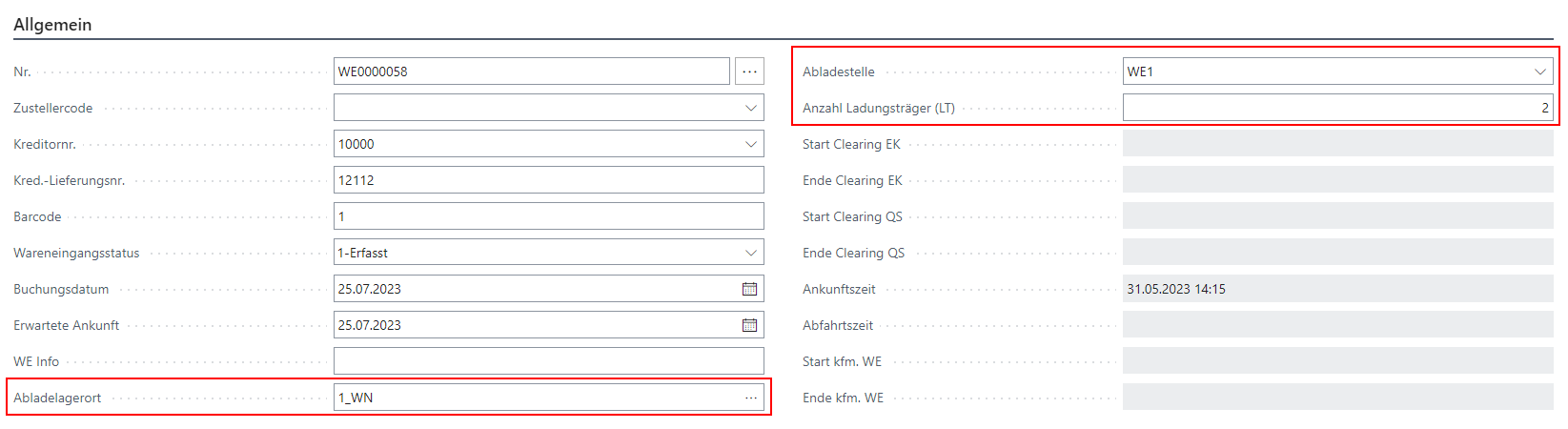
- the shipment can then be accepted with a forklift truck, for example. Here, the shipment note is marked by an employee in warehouse receipt with a copy of a blank barcode. The original barcode can be given to the forklift driver, who marks the corresponding shipment or pallet. The barcode is then entered in the corresponding field of the warehouse receipt.
- at this point, items can also be marked separately with item labels if required. To do this, select Print item label via the "Line" menu of the document lines after selecting the item.
- the document lines in the Qty. to Receive field are now filled with the quantity actually received and the line is accepted by clicking on Quantity checked. Load carrier lines are created according to the packaging hierarchy. If no packaging hierarchy exists for this item, as many pallets are created as are specified in the Number of load carriers field and the Qty. to Receive is distributed across them. The new storage place code in the load carrier lines is generated using the Inbound Stock Post strategy. You can adjust this if necessary.
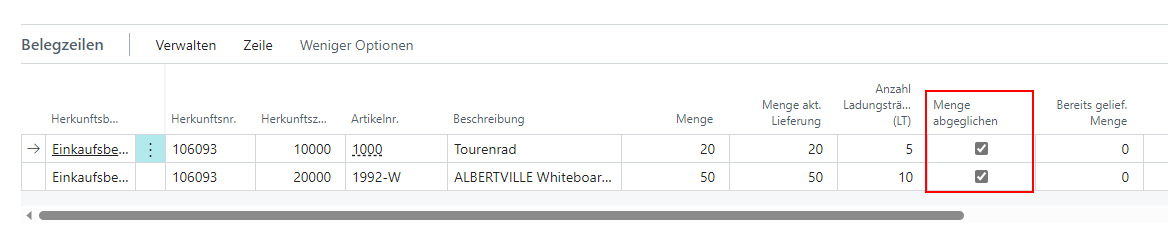
- for a better overview, a supplier package reference can be entered in the Comment text for label field. This comment text is printed on the package and enables the warehouse receipt employee to identify the individual package more quickly.
- then check whether the number of load carriers per document line still matches the quantities entered. If not, you can change the number. The Quantity checked field is deactivated again and must be set again.
- if necessary, you can edit the assigned load carriers in detail in the Allocated Load Carriers area. By changing the code, you can, for example, put items to other load carriers. The Detailed assignment of load carriers can also help here. You can use this to post different items to a load carrier, change the quantity assignment and create a print lead for the labels of all load carriers and items.
- now print the load carrier labels and attach them to the pallets. This will ensure that the pallets can be clearly identified in subsequent processes.
- You can now post the warehouse receipt. The prerequisite for this is that the setting Completion warehouse receipt is set to After commercial check.
- after the warehouse receipt has been posted, a move job list can be printed in the posted warehouse receipt. If no destination storage places can be found for an item, a place must be entered manually. The move order opens automatically.
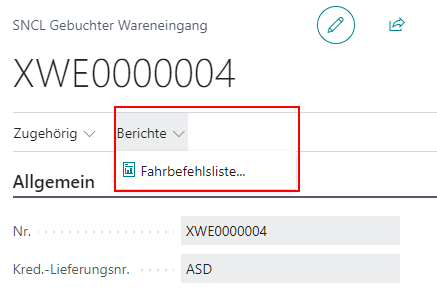
- to complete the warehouse receipt, search for the move job list by number on the move orders page and post it.
Perform a one-step physical warehouse receipt with MDE
Perform a two-step physical warehouse receipt with MDE
Warehouse receipt with GS1 barcode
The first use case where we have introduced GS1 identification is warehouse receipt. This section describes the changes in the process when you use GS1 identification.
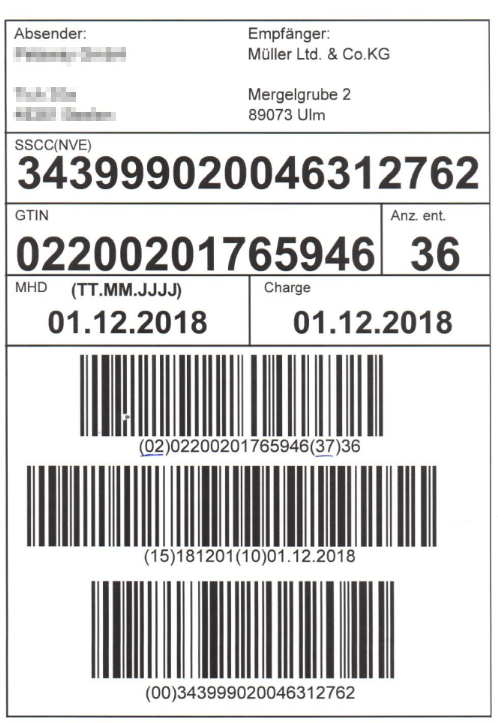
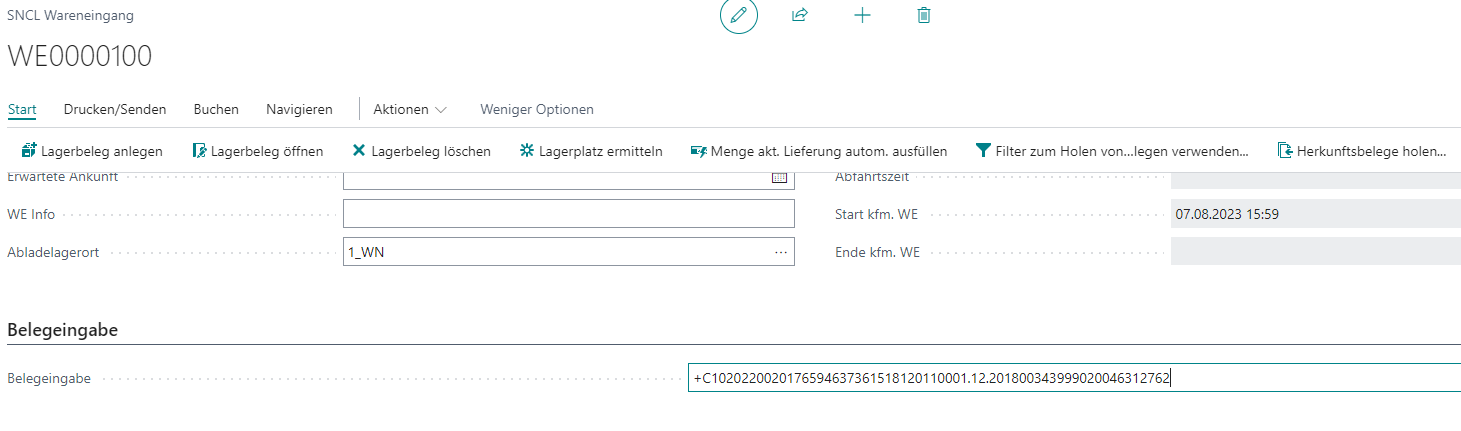
Instead of using Get source documents or Receipt entry normally in warehouse receipt, simply scan the barcode into the Receipt entry field. The system recognizes the specific GS1 barcode and changes its layout.
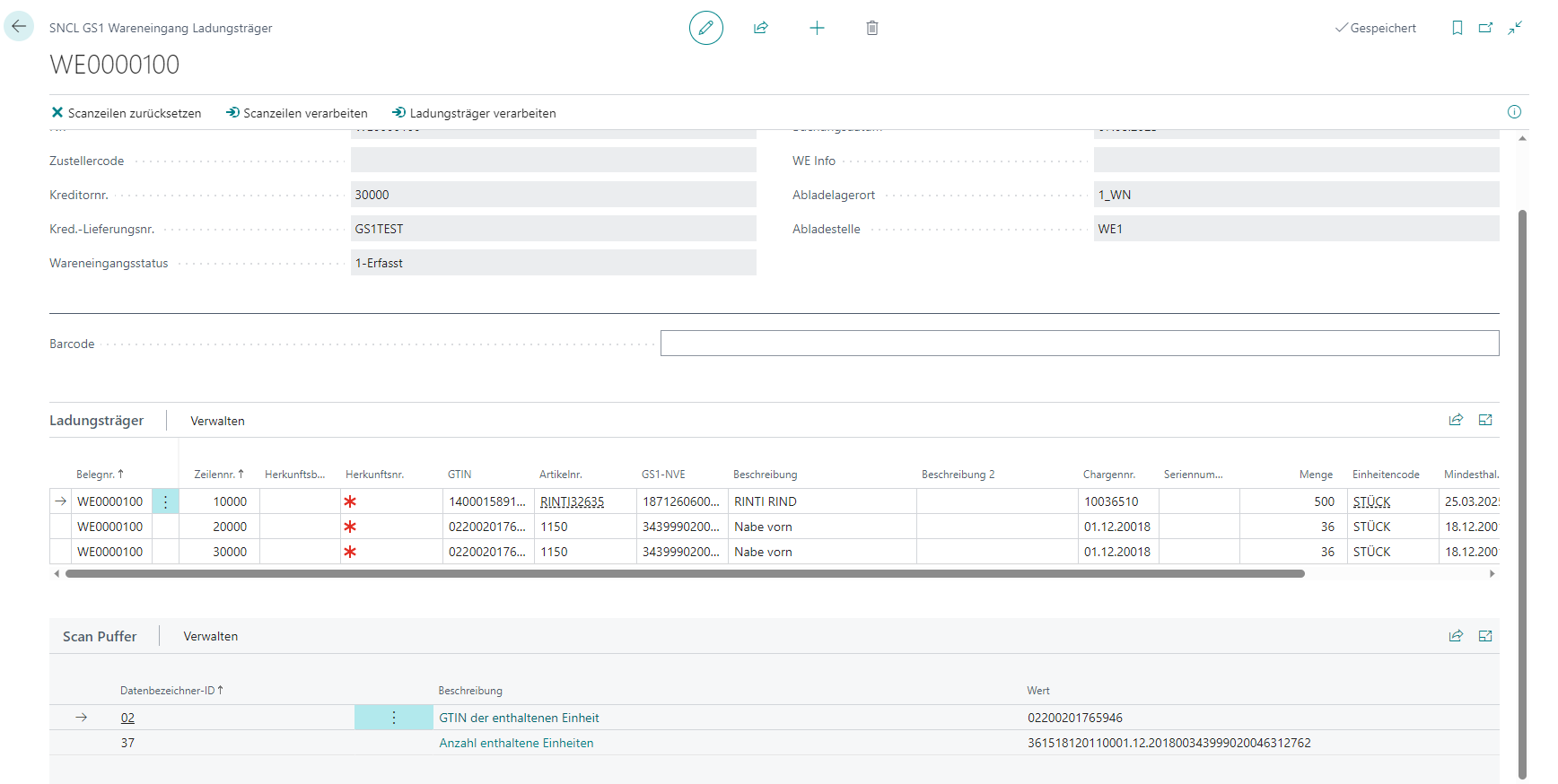
The screenshot shows that the system has already taken a lot of information from the barcode alone. In the Load carrier area, 3 load carriers with contents and lot no. have been entered.
Three descriptions can be seen in the Scan buffer area:
- 02 for the GTIN
- 37 for the number of units of measure received
This scan buffer shows all the descriptions that have been scanned in this process until all the mandatory identifiers for this warehouse receipt have been filled in. As soon as the last mandatory field has been filled in, the Process lines function is started. This means that the lines displayed on this page are transferred to the warehouse receipt.
These identifiers can be maintained in the GS1 SSCC identifier tables according to the vendor or customer. If no identifiers are entered there, the system assumes the GS1 standard and interprets the data during receipt entry based on the item master data entered.
Hinweis
If a Load Carrier has been recorded with a GS1 barcode, you can see this barcode via Related -> Show barcode references in the SNCL Load Carrier card. The barcode is always stored together with the check digit.
Warehouse receipt with GS1 barcode on the MDE device
This section describes how to enter a warehouse receipt from a GS1 vendor using the MDE device.
- A new warehouse receipt must be created at the beginning of the process.
 where you create a new warehouse receipt](doc_images_en/prozess_gs1_wareneingang_1.png) .
.

- Since the customer has assigned GS1 identifiers, A1.GS1 SSCC Receiving opens automatically.
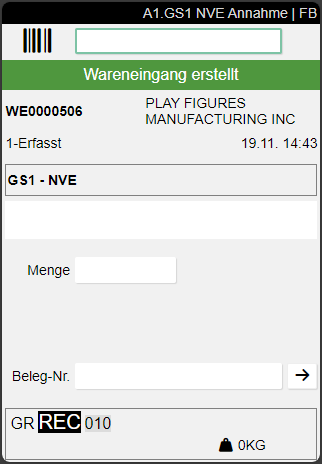
- Now scan the barcode.
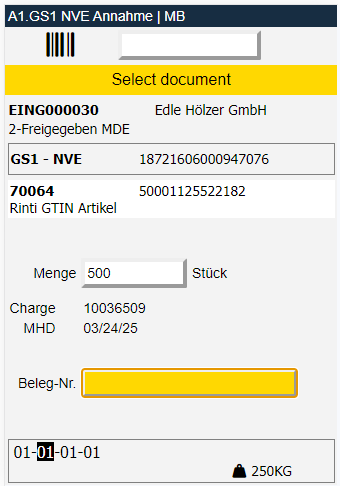
Hinweis
Alternatively, it is also possible to scan a Blanco Barcode in the GS1 Warehouse Receipt.
- Finally, the document number must be entered. Only then is the quantity completely processed and the corresponding load carriers generated. The stock document is also created. Processing is confirmed by the green coloring of the feedback.
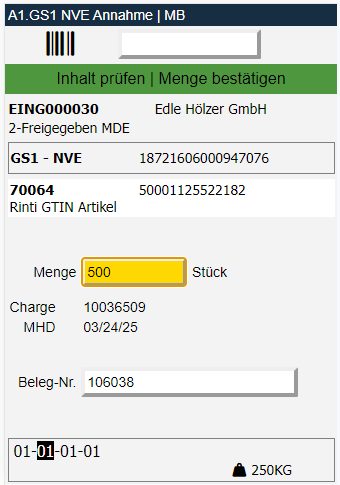
- The new load carrier is now shown in A1.2. You can now scan another GS1 barcode.
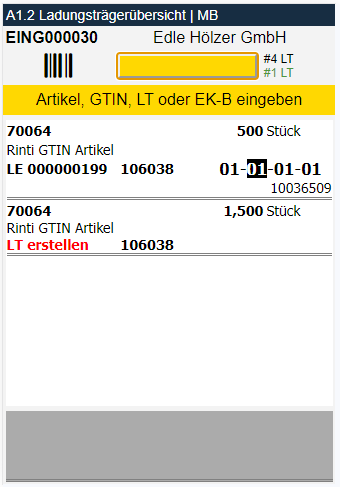
Generate Blanco Barcode
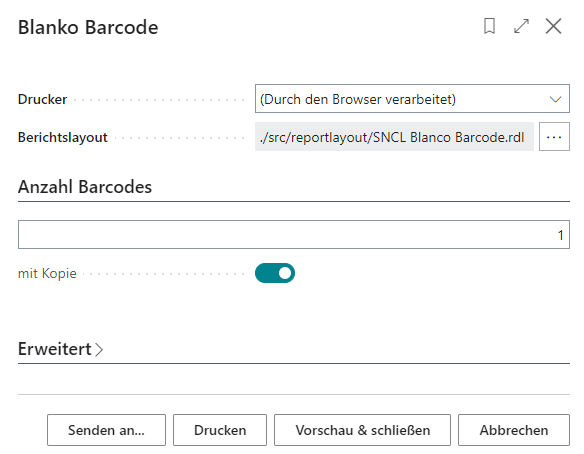
A Blanco Barcode can be used in the Warehouse Receipt to make a process identifiable. For this purpose, several barcodes are usually printed with a copy in stock and made available in the warehouse receipt or on the forklift that takes over the incoming transports.
You can create as many barcodes as you like using the Blanco Barcode report. Use the With copy radio button to select whether the corresponding copies should also be created. The copy of a Blanco Barcode always has the prefix K in front of the barcode number.
Process a document-oriented warehouse shipment
In this process description, a complete document-oriented warehouse shipment is carried out as an example. Please note that there are likely to be differences between the process described here and your warehouse logistics process. If you have any questions, please get in touch with your contact person at SIEVERS.
This process description assumes that the following setups have been made:
- Customer
- Shipping agents
- Logistics teams for picking and packing
- Storage places
- Inventory measures
Warehouse shipment essentially consists of 5 steps:
- Creation of a sales order
- Creation of a warehouse shipment
- Creation of a Outbound Stock Post
- Execution of the internal logistics steps a. Picking b. Packaging b. Packaging c. Loading
- Posting of warehouse shipment
Creation of a sales order and warehouse shipment
This step does not differ from the creation of a sales order in the Business Central standard.
- Create a new sales order via the sales orders list
- Enter all information relevant to the sales order. You can also enter details such as the packing team, unloading place or priority in the SIEVERS WMS section.
- Once you have finished, release the sales order. During this process, the sales order is checked for the correct entry of mandatory fields.
- Then generate the warehouse shipment from this sales order.
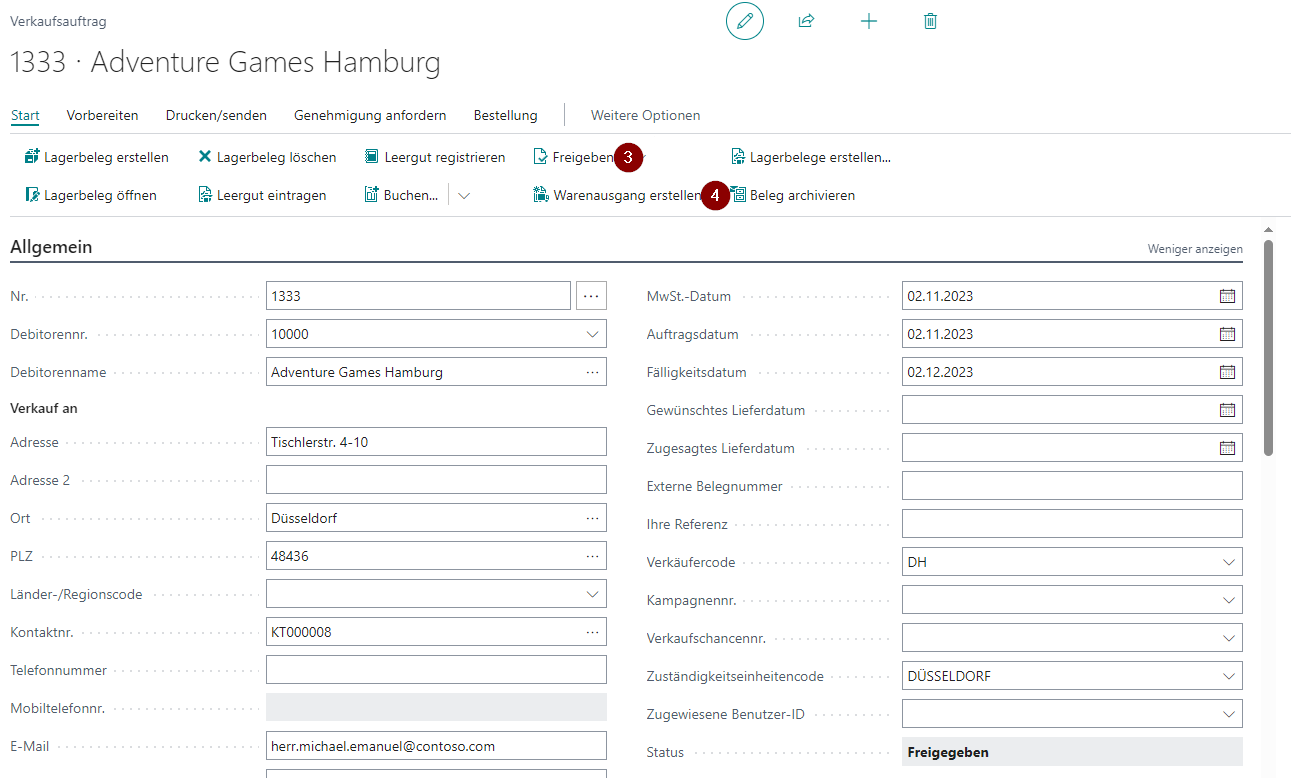
- The Warehouse Shipment Planning opens automatically and confirms the successfully created warehouse shipment. This has now also been automatically marked in the overview.
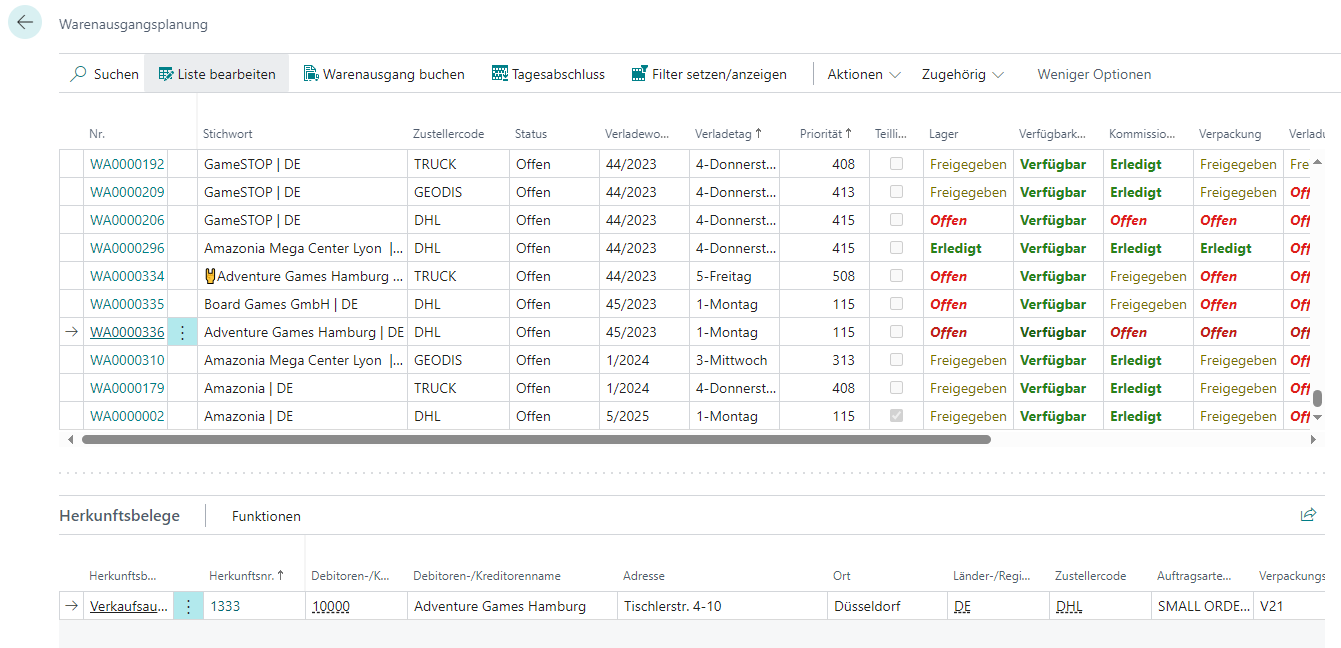
If you add new lines to the sales order, they are not automatically added to the warehouse shipment. If you want them to be, you have to activate the Add to Warehouse Shipment from Source option in the SIEVERS WMS Setup.
Creation and progress of the warehouse shipment document and picking document
- Now create the stock removal document from Warehouse Shipment Planning. Please note that all assigned orders must have a packing team defined. If this is not the case, you can do this in the source documents table below.
Hinweis
Please make sure that the SIEVERS WMS teams are correctly maintained. Only then can the appropriate teams be assigned automatically.
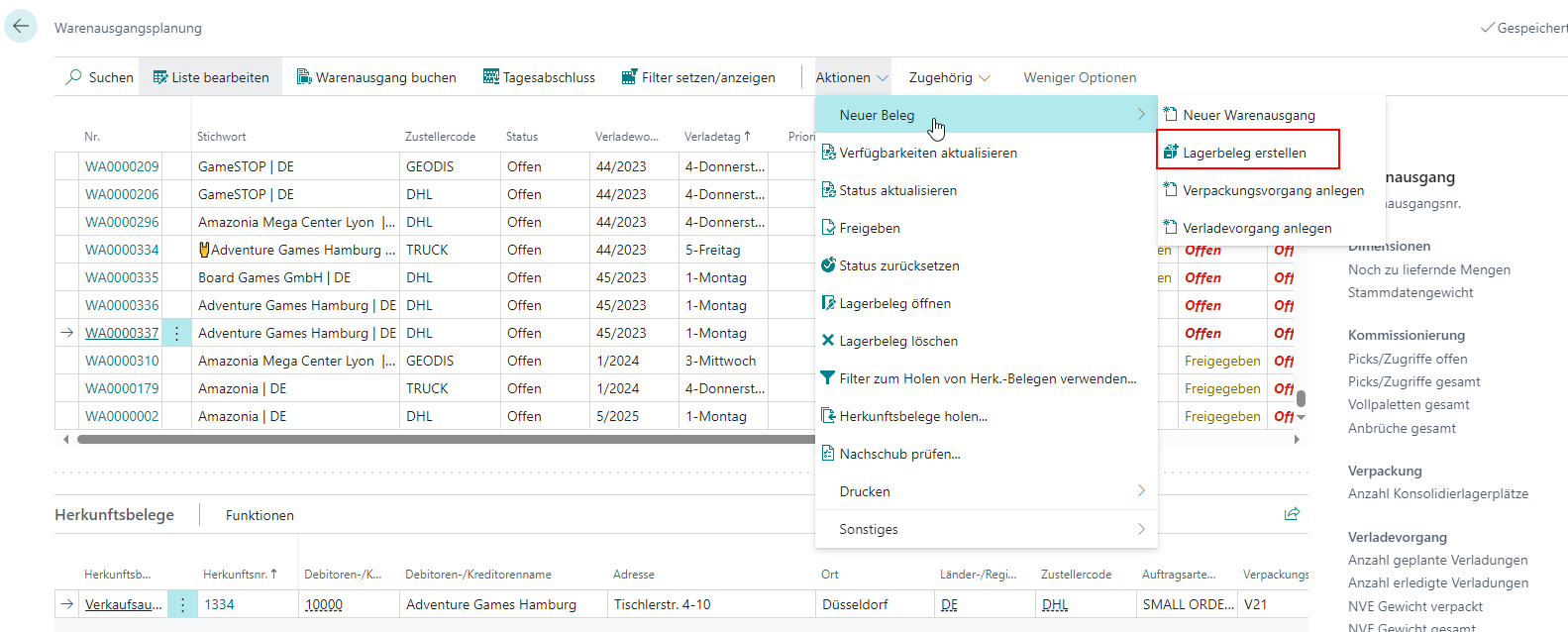
- A picking document is automatically created and the Pick documents print/release view is opened. You can now select to print the picking document. Leave the settings as they are. You should only adjust the printer selection to a printer available to you.
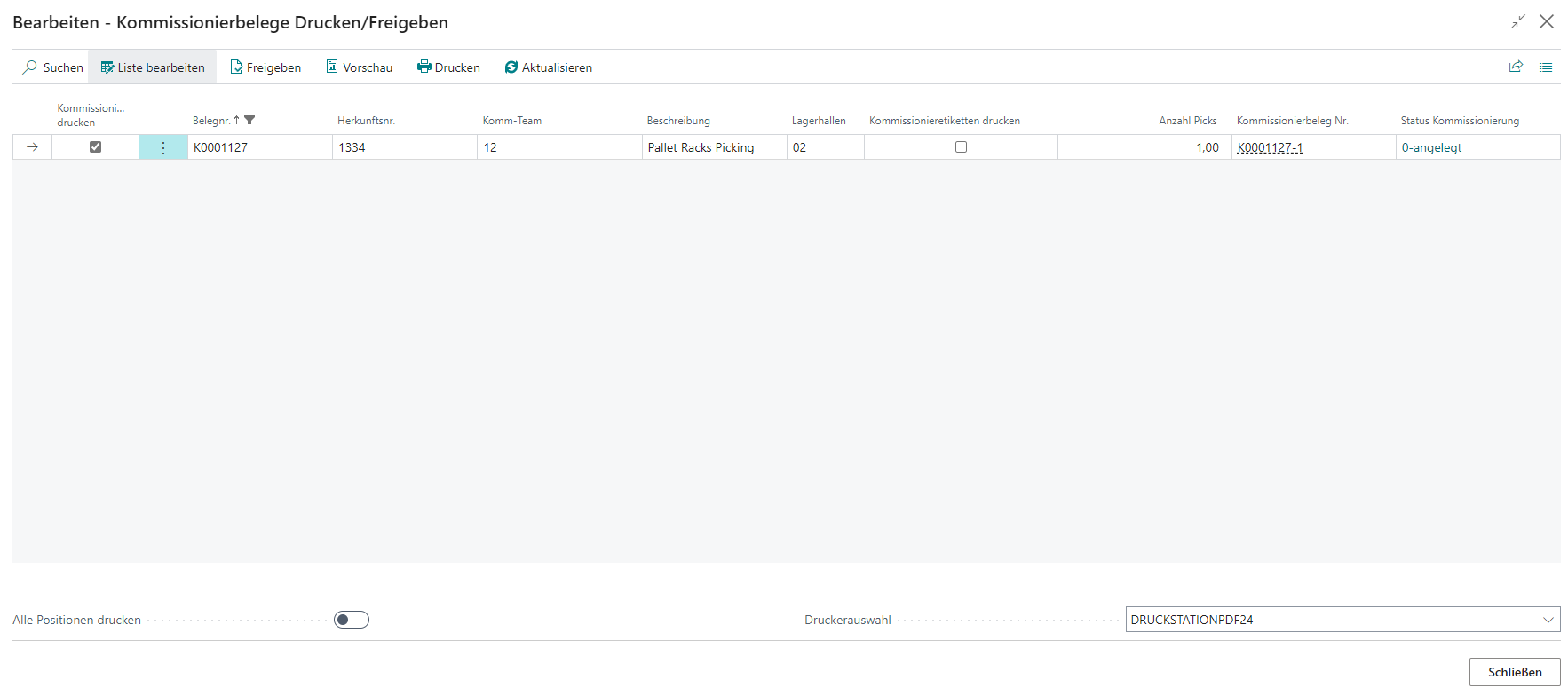
- Now print the picking document via Print. The finished document looks something like this:
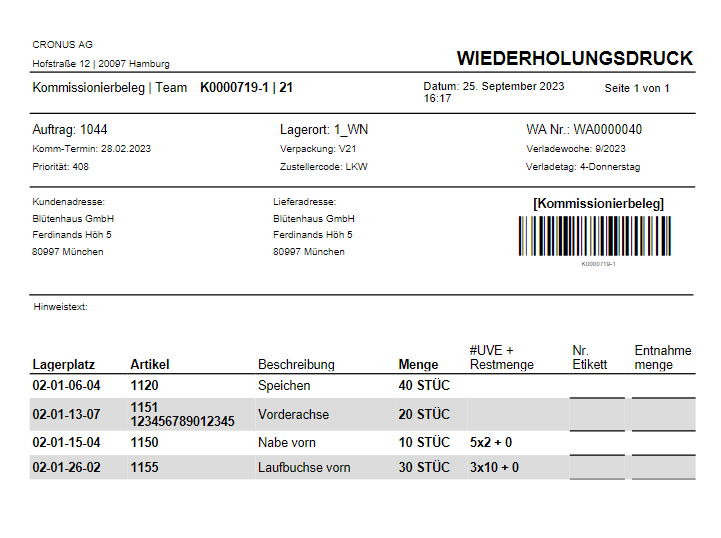
- The picker now has the task of carrying out the picking with this picking document and enough Blanco Barcodes.
- To do this, he goes through the items in the document one after the other and adds the picked items to a picked load carrier (PTU). To do this, he scans a Blanco Barcode, sticks it on the picking document and numbers it. He enters this number in the Label no. field. The picked quantity is entered in Picked quantity.
- When the picker is finished, he takes the load carriers with the picked items to the place where the picking document is confirmed. Here, the Blanco Barcodes are scanned into the scan field of the picking document in Business Central and new Load Carriers are created.
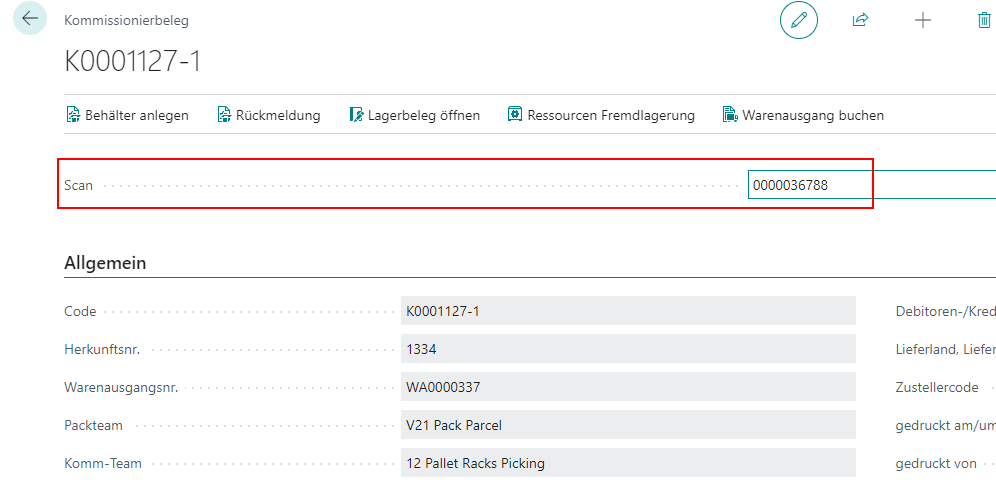
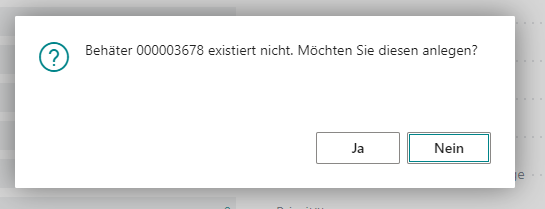
- a new Load Carrier is then added at the bottom of the Picking load carrier lines area. First select the correct inventory measure (1). Then transfer the Label no. from the load carrier lines (2) to the corresponding field in Number of positions (3). This assigns the items to the load carriers. It is also possible to assign items from other orders to this PTU as long as they are assigned to the same warehouse shipment.
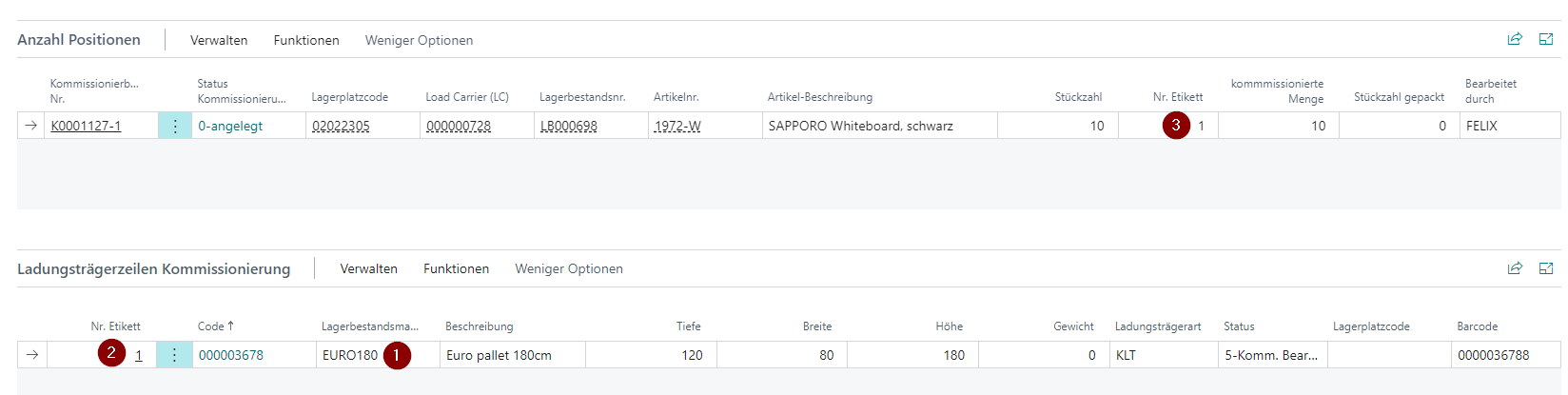
- if the picking team is linked to a packing team via logistics team setup, a suitable storage place code is automatically entered in the Picking load carrier lines, which serves as a transfer to the packing team. If this is not the case, you can also enter one manually by selecting Post Load Carrier to storage place under Functions.
Hinweis
If a picking document is completely picked, all associated PTUs and SSCCs are set to state 2-recorded or to state 7-packed.

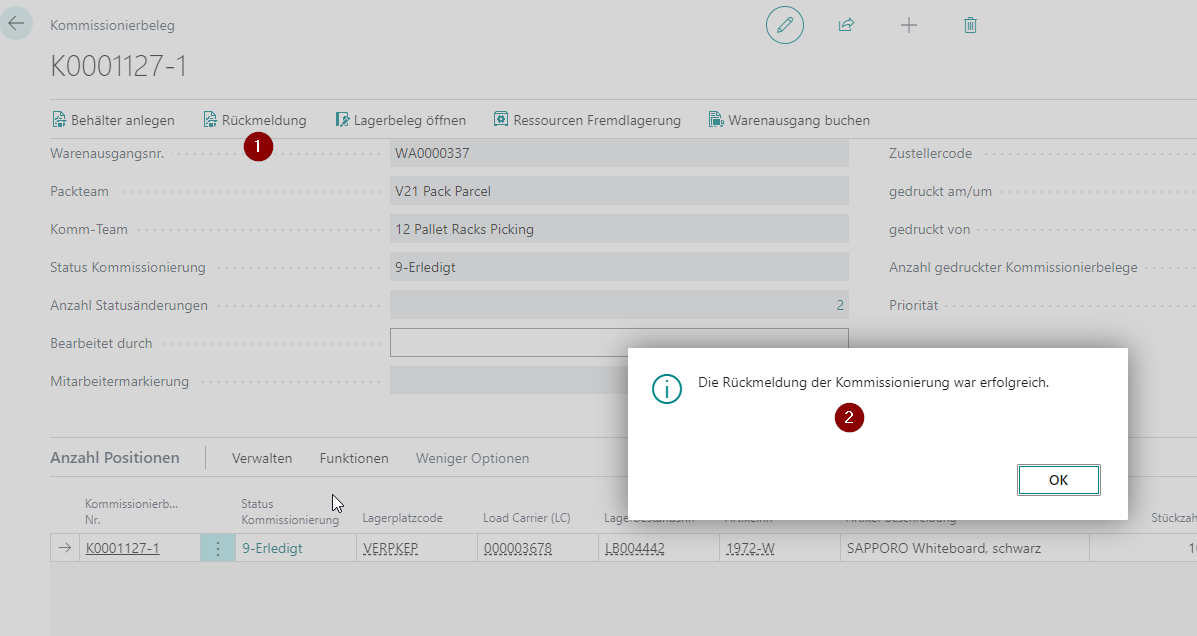
- you can now respond to the picking document (1). If everything was successful, a corresponding message is displayed (2). If the number of pieces column in the picking items contains a smaller quantity than the total quantity to be picked, only a partial response is issued.
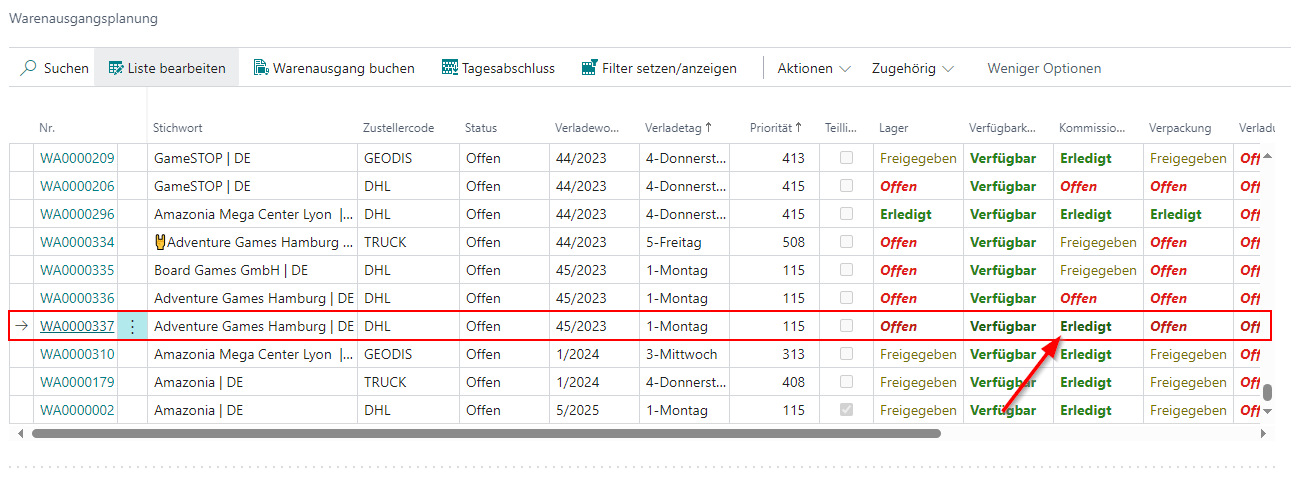
- the state of the document and the individual items in the picking area is now set to 9-Done. This is also reflected in Warehouse Shipment Planning.
Hinweis
After posting the warehouse shipment, the used/filled PTUs are automatically archived and can then be found in the post. Load Carriers list. Empty PTUs are not archived.
As soon as the first PTU has been created and has the state 2-Recorded, a packaging process is automatically created.
Perform A Picking Series
A picking series is a combination of several orders in one picking process. This means that the picker does not have to process one order at a time, but is assigned the picking of items from various similar orders, which can save time and travel.
Please note that the following must be prepared for a picking series:
- Picking series no. stored in the SIEVERS WMS setup
- Series picking must be activated in the SWMS Feature Setup.
- Order Types must be active for series creation
- The Picking team must have the series picking option activated
- A correct series creation strategy must be created
- There can be an automatic run of the SNCL Create Picking Series task in the job queues
Essentially, the progress of a picking series works like normal picking, especially if Automatic release is checked in the series creation strategy. This means that the picking series does not have to be released via the series monitor. After creating the stock document for an order in Warehouse Shipment Planning, the picking series is progressed as follows:
- If SNCL Create picking series does not run automatically, you must perform this task manually. To do this, select the desired series creation strategy in the task and execute it.
- If the series creation strategy has been configured correctly, you can now view the series created in the series monitor. If you have activated automatic release, a picking document has already been created that can be carried out. Otherwise, you must release the series via the series monitor. Depending on the release, the series currently has the state 0-Created or 1-Released.
- A largely normal picking document has now been generated. The difference is that the source no. and the warehouse shipment no. are empty and the picking series no. has been filled instead. The reason for this is that this picking can contain several orders and therefore cannot be assigned to either an order or a warehouse shipment. The picking lines were combined as far as possible using the Load Carrier no., storage place no. and item no. The consolidation number is incremented according to the packing together rules to ensure correct order separation during packing.
- The employee now progresses the picking as normal - with the difference that he does not pick into PTUs, but into series transport units (STUs). As soon as the picking document is printed or the process is selected on the MDE, the series changes to the 2-In Progess status.
- Once all positions have been picked, the document changes to 3-Picked.
- If a shortage has been found, the system automatically detects this circumstance and either finds an alternative stock or changes to status 5-In Clarification.
Now the picking is complete. The picked items are now in STUs but must be distributed to the appropriate orders. This is where serial distribution comes into play.
Perform a Series Distribution
This process covers the distribution of items that have been collected in STUs with a picking series to their matching orders.
- As a rule, after completion of the picking series or placing the first carrier, a series distribution was automatically created via a mobile device. You can see this in the SNCL Series Monitor based on the already assigned Series Distribution No.. If there is no number there, this is due to the activated WMS setup Disable Automatic Serial Distribution Creation. In this case, you can also manually create the series distribution with the action Release Series Distribution in the Picking Series Monitor.
- Open the appropriate series distribution via the Series Distribution No. or the list Series Distribution. This is empty when first opened. To start the process, scan or enter the first STU No. in the appropriate field.
- The table in the middle and the order quantities table will then fill with the content of the entered STU.
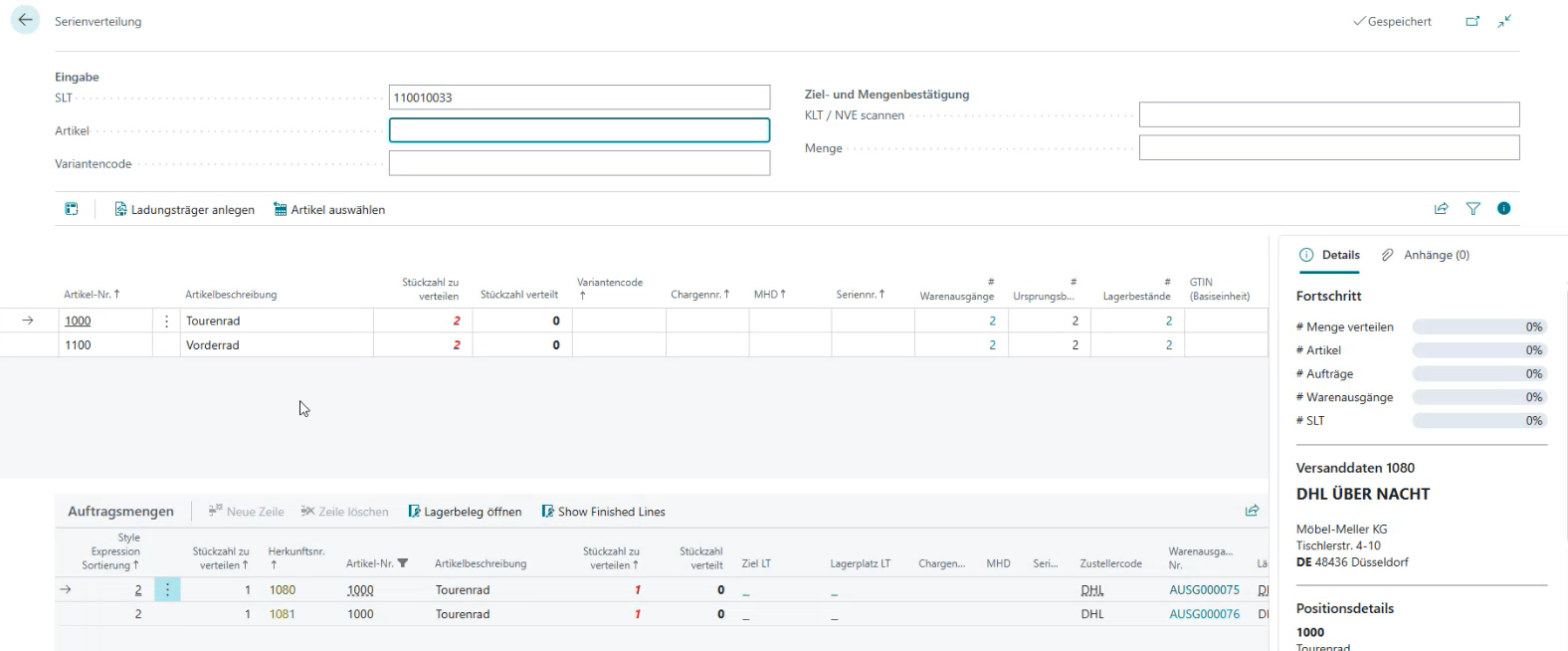
- The table in the middle shows the actual content, how much of the item still needs to be distributed and how much has been distributed. The order quantities table shows how many items from the STU are to be distributed to which orders. This can be identified by the source no., the warehouse shipment no. and the number of pieces to distribute field. The colors of the source numbers mean the following: Green: With the currently selected line, the order is complete and can be made ready for shipment and shipped | Yellow: The source document receives several more lines with the same distribution process | Red: For the order, there are lines in other pick lists or open lines in the warehouse shipment. The order must be consolidated after the line in the packaging or later.
- Now select the item that is on top or most easily accessible to you, and scan the number in the Item field. Both lists in the middle will then be filtered to this item. If necessary, enter a variant code. You can change the storage place manually.
- Now you can see in the Order Quantities table or in the FactBox how many pieces need to be packed for each order.
- Scan a blanco barcode or an existing PTU/SSCC in the Scan PTU / SSCC field or create a new carrier via action. This will write this carrier number to the Target Load Carrier field at the selected position in the Order Quantities table. The Storage Place Load Carrier field should now show the storage place of the packing team where you are ideally located.
Hinweis
The system automatically prevents uncontrolled packing together. Source document lines from different warehouse shipments cannot be packed into the same load carrier. If the "By Order" flag is additionally active on the warehouse shipment, different orders also cannot be packed into the same PTU or the same SSCC.
- Place the item in your hand into the new carrier and enter the quantity in the corresponding field. This reduces the number of pieces to distribute in both tables and in the Order Quantities table the entered quantity is shown in the current line in the number of pieces distributed field.
- Then take the next item from the STU and continue with the process. Scan item, enter variant code if necessary, scan target carrier, enter quantity. The FactBox or the top line in the order quantities tells you how much you should pack into the carrier. Over time, the progress bars in the FactBox change. If the source no. in the order quantity line is green, this is the last item of this type for this order.
- You do this until the STU is empty. Then you take the next STU and continue. Scan item, scan PTU, enter quantity. The order of the items does not matter. The series distribution always automatically filters to the correct lines and orders. Multiple STUs can also be processed simultaneously.
Create and Execute MOP Batch
A MOP batch combines multiple orders for multi-order picking. The picker processes items from different orders simultaneously, saving time and travel distance. Important difference to series picking: Picking is done order-pure into separate containers/compartments.
Prerequisites:
- MOP batch number series stored in SIEVERS WMS Setup
- Order types activated for MOP batch creation
- MOP batch creation strategy created
- At least one MOP cart with configured compartments available
- Warehouse shipments released
- Optional: Automatic run of task SNCL Create MOP Batches in job queue
Create MOP Batches
Prerequisites for orders:
- Status: Released
- First loading date within the lead time horizon (delivery date)
- Meet the filter criteria of the strategy (order type, delivery country category, customer filter)
Creation - three options:
1. Via search (Ctrl+Q):
- Ctrl+Q → SNCL Create MOP Batch
- Optional: Select specific MOP batch creation strategy (empty = all active strategies)
- OK → System shows number of created batches and orders
2. Via warehouse shipment planning:
- Open warehouse shipment planning → Create MOP Batch
- Optional: Select strategy
- OK
3. Automatically via job queue:
- Job queue entries → New entry with codeunit SNCL Create MOP Batches
- Define execution interval (e.g., hourly)
- Optional: Filter to specific strategy
- Activate entry
Hinweis
If the Custom Event field is filled in the MOP batch creation strategy, an event with the stored code is triggered instead of the standard process.
Batch creation logic:
- Order determination: System determines qualified orders according to criteria (status, order type, delivery date, filter)
- Sorting: By loading date (ascending) and priority (smallest first)
- Batch composition:
- Considers all SNCL outbound warehouse entry lines with code MOP Batchwise
- Observes max parameters (number of orders, lines, number of pieces)
- Applies filter criteria (shipping address, packing team)
- Complete source documents are included (no splitting)
- Batch completion: When a threshold is reached, batch is completed, additional orders go into new batch
- Batch assignment: Unique MOP batch ID is assigned
- Status: Newly created batches receive status 0-Created
Hinweis
If the min. number of orders is not reached, the batch remains in status 0-Created and must be released manually or discarded.
Execute MOP Batch
Phase 1: Preparation
Create warehouse document:
- Warehouse shipment planning → Select source documents → Create warehouse document
- Quantities are immediately reserved (field "Quantity in Picking")
- Picking team is assigned (only MOP teams)
- Fields remain empty: MOP batch no., consolidation no., picking document no.
Create MOP batch:
- MOP monitor → Create MOP Batches
- Batch status: 0-Created
- Fields still remain empty (are only filled upon release)
Phase 2: Release
Release MOP batch:
- MOP monitor → Select batch (status 0-Created) → Release MOP Batch
- System automatically executes:
- Assign MOP batch no. → Groups lines for A4.1
- Assign consolidation no. → Controls packing together (see Packing together rules)
- Create picking document → Type: MOP-PICKING
- Update quantities → Status: "In Picking"
- Batch status: 1-Released
Hinweis
MOP batch no. vs. consolidation no.:
- MOP batch no.: All lines of the batch have the same number → Are displayed together in A4.1
- Consolidation no.: Different numbers depending on packing together rules → Controls what may be packed together
Important: In contrast to series picking, not everything is packed together, but order-pure into separate containers/compartments.
Phase 3: Picking
Pick on MDE:
- Open A4 Picking
- A4.1: Batch is displayed as one operation (grouped by MOP batch no.)
- A4.2: Positions are displayed (cumulated only within one order)
- A4 MOP PTU LC Assignment: Assign MOP Boxes to orders and PTUs
- A4.3: Pick items - System validates consolidation no. when scanning into container/compartment
- Batch status: 2-In Picking → 3-Picked
For a detailed explanation please read A4 MOP PTU LC Assignment.
Packaging
The packaging process in Business Central is based on three central pages:
- SNC Packaging Card 1 PTU>SSCC: Starting point and main process
- SNC Packaging Card 2 ART>SSCC: Allows the PTU content to be assigned to SSCCs at item level. In exceptional cases, individual item quantities can also be assigned to a SSCC
- SNC Packaging Card 3 SSCC>PTU: Allows the SSCC contents to be viewed and corrected. For self-checking by the packager
The packaging process bracket is the packaging card information.
Process:
- Normally, a packaging process should have been created automatically by the system as soon as the first PTU was created during picking. Otherwise, create a new packaging process in Warehouse Shipment Planning via Actions -> **New Document -> Create Packaging Process.
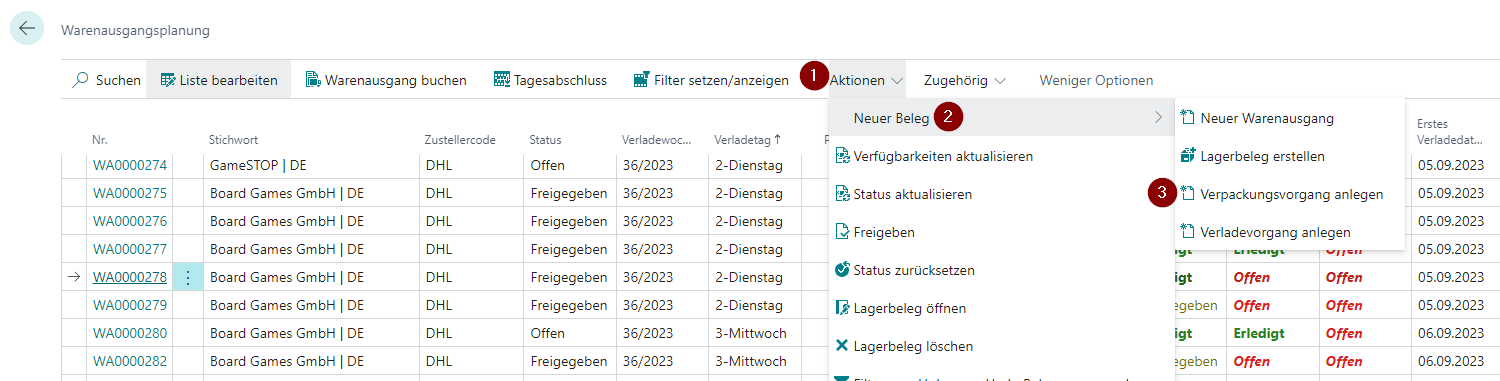
- This action not only creates the packaging process, but also directly opens the page with which the further process is continued: SNC Packaging Card 1 PTU>SSCC. The previously created PTUs (see screenshot below: 1) are automatically assigned to this packaging process. If you did not have to create a new packaging process and have already opened it, switch to SNC Packaging Card 1 PTU>SSCC via Actions -> Show SSCC/SSCC Information.
- Now scan the first PTU barcode in the Scan PTU(2) field. It is not possible to enter the code as the check digit of the barcode is missing here.
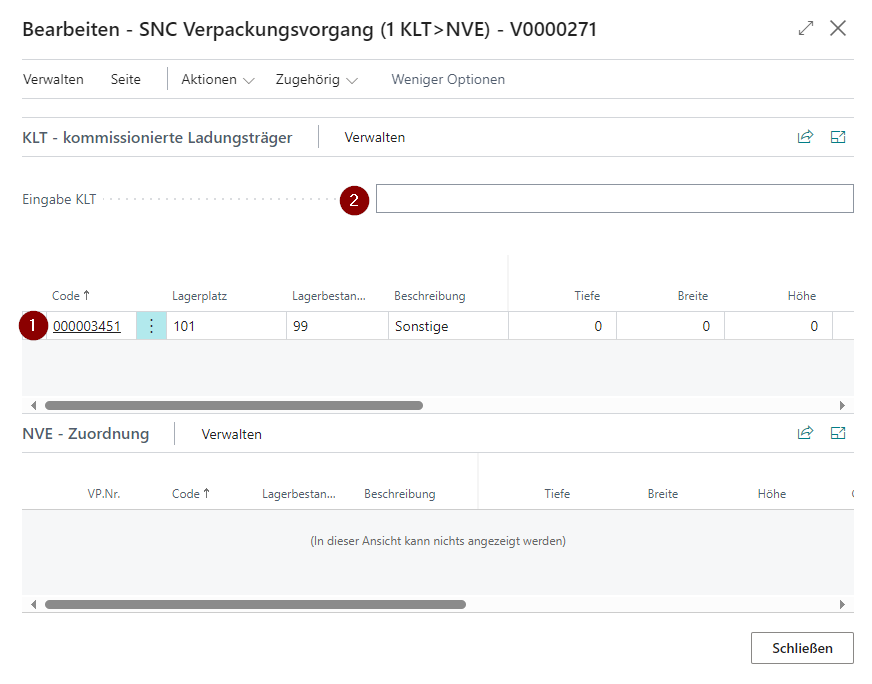
- After scanning the barcode, the system will automatically focus on the SSCC (Packaging) field in the respective PTU line. Now pack the item and scan an existing SSCC or a Blanco Barcode.
Hinweis
It is also possible to scan the PTU barcode again. This converts the PTU 1:1 into a SSCC. If you want to undo this, simply remove the VP.no. assignment.
- A new line has now been created in the SSCC - Assignment lines with the state 2-Recorded. This means that the package to be shipped has been created. In the course of this, the PTU State in the top line has been set to 9-Finished. The picked load carrier has therefore completed its progress. If you have activated the Load Carrier option Archive Delivered Load Carriers in the SIEVERS WMS Setup, the load carrier is automatically archived and can be found again via Posted Load Carrier.
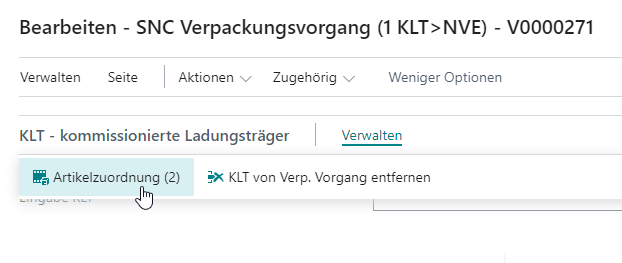
- If you want to assign more items to the SSCC or divide the item quantities among several SSCCs, use the Item Assignment. This can be found in the Manage menu of the PTU lines.
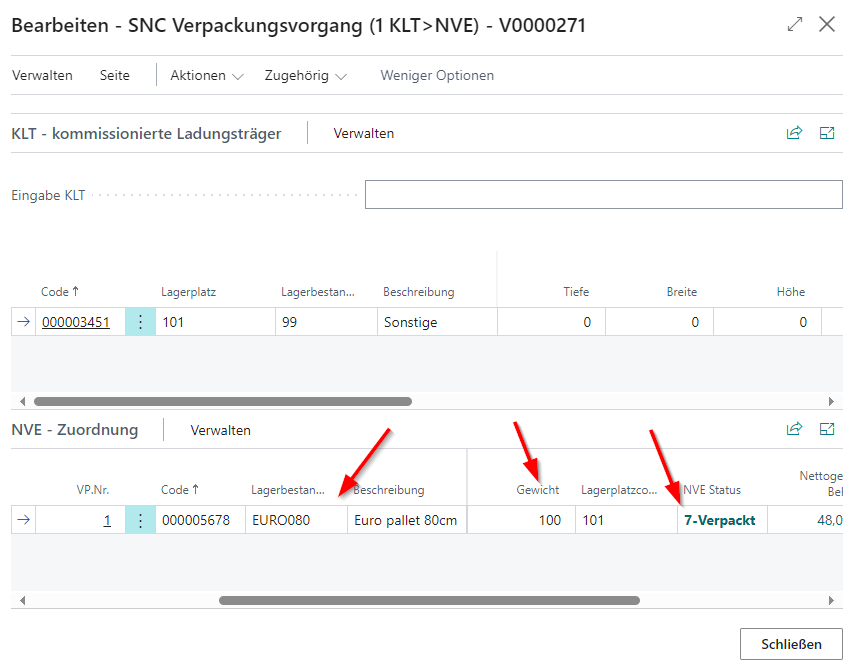
- Now weigh the finished SSCC load carrier. Then enter the correct inventory measure and a weight in the SSCC assignment line. As a result, the SSCC state is set to 7-Packaged.
Hinweis
If you remove the dimensions or weight again, the state of the SSCC is reset to 2-Recorded. If you enter the data again, it will automatically change to 7-Packed.
- Repeat steps 3 to 7 to add further PTUs to a SSCC.
- Once a SSCC is completely filled, you can access SNC Packaging Card 3 SSCC>PTU via Manage -> SSCC Content (3) and check your work. The SSCC and its contents are shown here broken down. If you realize that you have packed an item in the wrong SSCC and want to change it, simply enter the correct Packaging No. in the content line.
Hinweis
If you want to remove an item from a SSCC, remove or change the Packaging No. assignment. If the SSCC becomes empty, the system will offer to remove the SSCC.
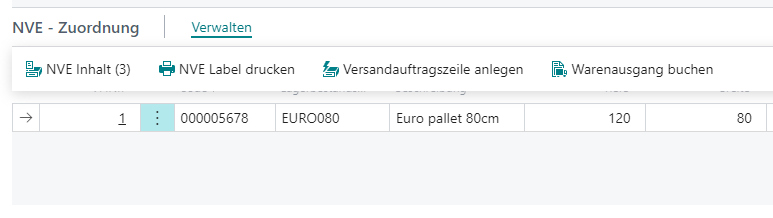
- The SSCC state is now 7-packed, so the SSCC label can now be printed. Depending on whether the package contains more items than specified in the Min. Item Qty. SSCC Pack. Cont. setup field, an additional SSCC Package Content List is printed and must be attached to the package. Select the SSCC and print the label via Manage -> Print SSCC label.
Hinweis
In series distribution, the automatic SSCC label print can be disabled via the setup field Disable autom. SSCC label print in Series Distribution in the SIEVERS WMS Setup. In this case, printing is only done manually via the corresponding action.
- When you are finished, you can either post the warehouse shipment directly via Manage or create the shipping order lines, depending on the Shipping Agent settings.
Item Assignment
On the SNC Packaging Card Item SSCC (2 ITEM>SSCC) page, you can manage the item assignments of the PTUs to SSCCs. You can:
- Freely assign items to any SSCC and
- Split item lines and assign them to different SSCCs
Process:
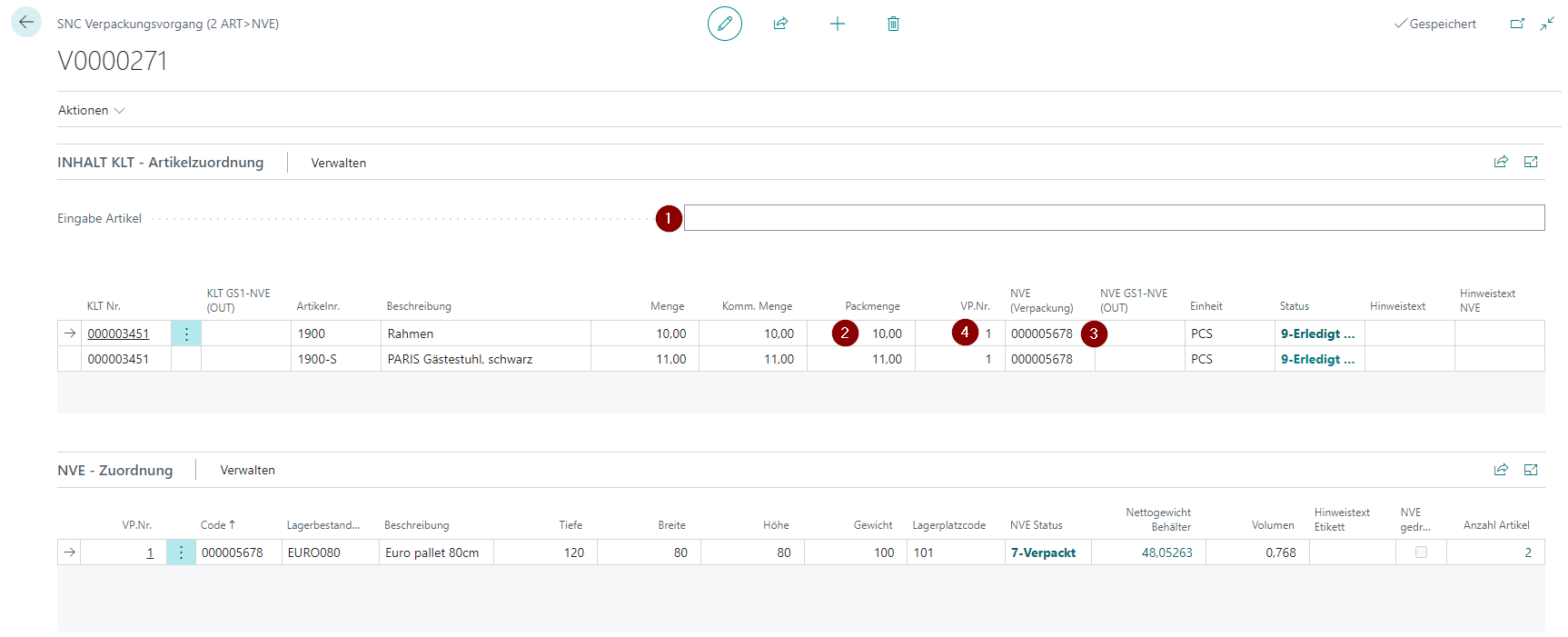
- Scan the item you want in the Scan Item field
- Enter the pack quantity
- Scan the SSCC into which you want to pack the item in SSCC (Packaging).
- The item line is now assigned the appropriate Packaging No.. If you want to change the assignment, you can adjust it
It is important that you always scan the item before progressing.
Shipping
If a shipping agent who has not deactivated No shipping orders is entered in the warehouse shipment, a shipping order is automatically generated. Shipping orders are part of the SIEVERS Shipping module and are used to generate and manage shipping labels. Please make sure that you have set up SIEVERS Shipping correctly.
- Access the list of assigned shipping orders via Factbox in Warehouse Shipment Planning by clicking on the Number of Shipping Orders and select the shipping order.
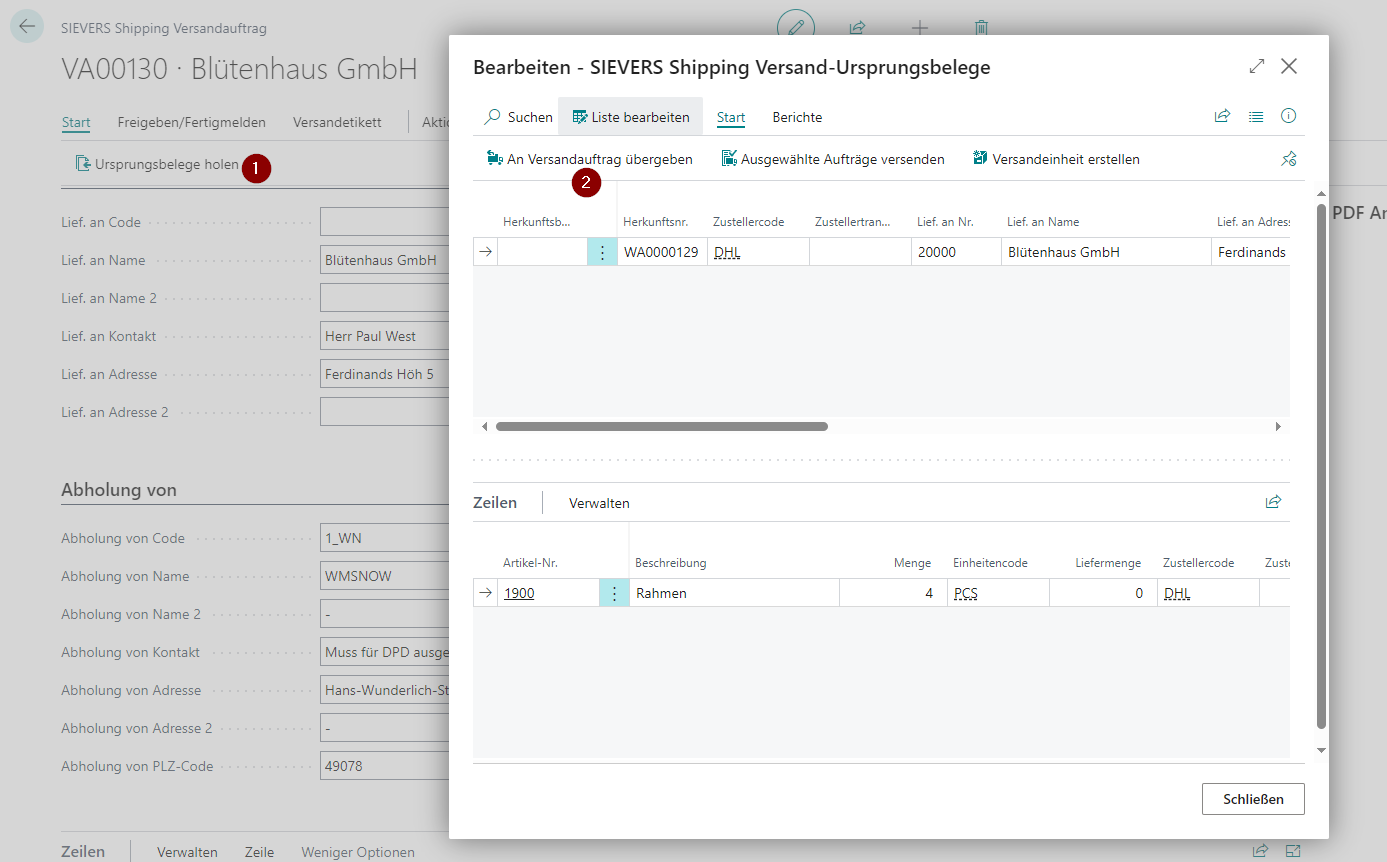
Ideally, the shipping order lines should have been generated automatically during picking or packaging as soon as the Load Carriers are of type SSCC and state 7-Packed. If this is not the case, you can also generate the shipping order lines manually. Please read the next step. Otherwise you can continue with step 4.
Via Home -> Get Source Documents you can now assign the existing SSCCs of the warehouse shipment to the shipping order. To do this, click on Transfer to Shipping Order in the mask. If you have already carried out the Create shipping order line action for all Load Carriers during picking or packaging, this step is no longer necessary.
- You can now print package content lists or shipping labels for the individual lines via Line -> Functions.
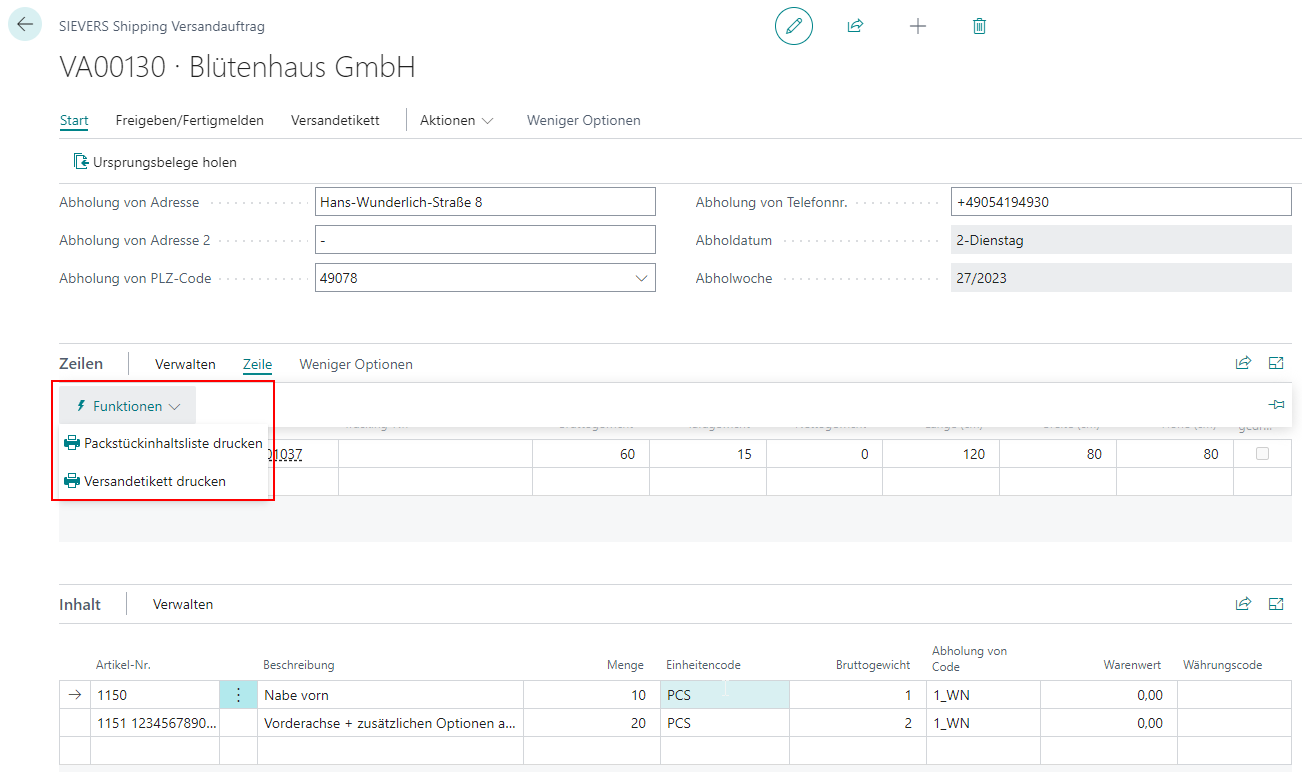
- When you are finished, finish the document so that the warehouse shipment can be released and posted. The shipping order now becomes an archived shipping order, which can be viewed in the corresponding list Shipping Order Archive List.
Loading
If the [shipping agent](#shipping agent) has activated the loading required flag, a loading process must be created for a warehouse shipment.
- To do this, create a new shipment process via Actions -> New document in Warehouse Shipment Planning. Enter the number of shipment processes you want to create in the Number of Processes field (1). Then click on the three dots to go to Create (2). When you are finished, you can click on OK and a table will be shown with the shipment processes that have been created. These initially have the state 0-created.
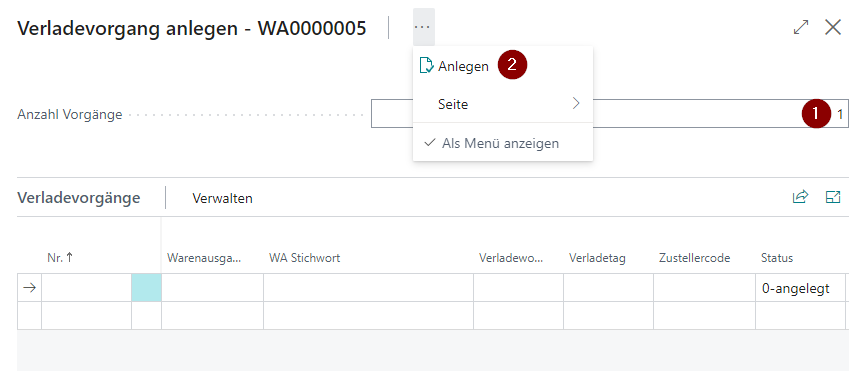
Hinweis
You can create as many shipment processes as you like for a warehouse shipment. If a load carrier is assigned to the process in the shipment process lines and thus marked as loaded, it automatically disappears from the other shipment processes. This prevents inconsistent data.
- Now open one of the shipment processes. The General area has been pre-filled with data from the warehouse shipment. In addition, the Logistics Team, the Loader and the Loading Storage Place are filled with data from the shipping agent. You can now fill in Planned on and Planned at.
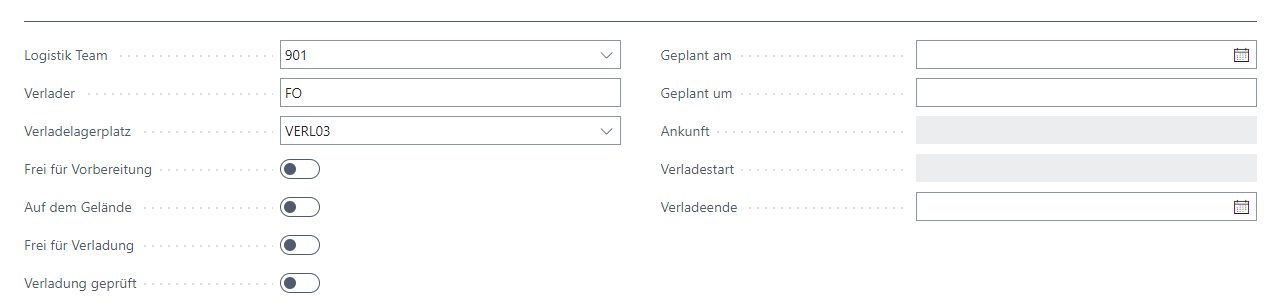
- When the transport vehicle has arrived, the check mark is set at Arrived on yard. This specifies the arrival time.
- Since some time elapses between the arrival of the vehicle and the actual start of loading, the start of loading is only set when the license plate Released for loading is activated. The prerequisite for this is that at least one load carrier with the state 7-Packed is in the loading process.
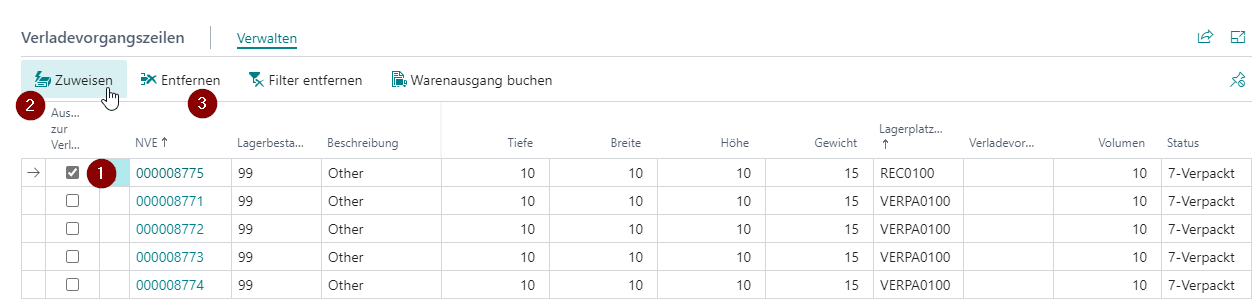
- Now the loading is carried out. To do this, click on the Confirm for Shipment Process (1) check box in the shipment process lines for the loaded load carriers and then on Assign (2). The checked load carriers have now been assigned to this shipment process and the state has been set to 8-loading.
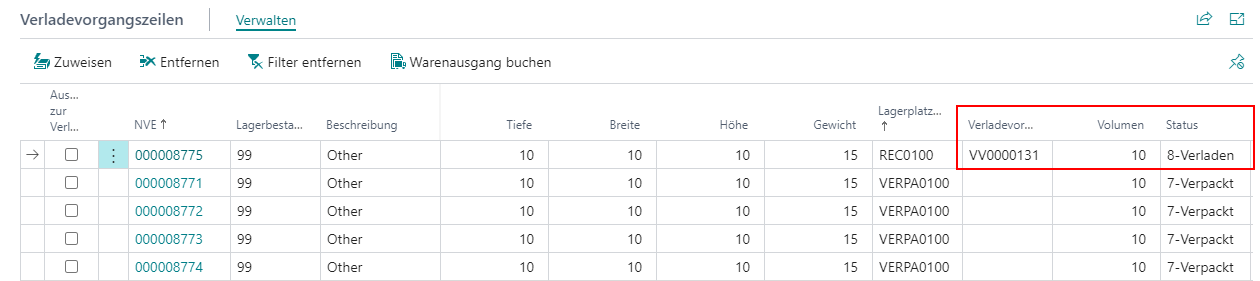
If you now close this shipment process and reopen it or switch to another shipment process belonging to this warehouse shipment, you will notice that the load carrier you have just assigned is no longer shown in the shipment process lines. This is because it is no longer relevant for loading and has been filtered out. This also prevents the same load carrier from being accidentally assigned to different shipment processes. If you want to see the SSCCs that have already been loaded, you can Remove filter.
Once loading has been completed and checked, the Loading checked indicator is set. This also marks the end of loading. In this step, you can also immediately post the warehouse shipment.
Hinweis
Reusable load carriers are automatically reset after the warehouse shipment posting. If the Chg. Load Carrier Type allowed flag is set, the load carrier type is changed to SU, the status is reset, and the order assignment is removed. The load carrier is then available again for new warehouse processes. If a Default Storage Place for Reusable LC is stored in the SIEVERS WMS Setup, the load carrier is automatically posted to this storage place. The load carrier is then available again for new warehouse processes.
Add to a SSCC
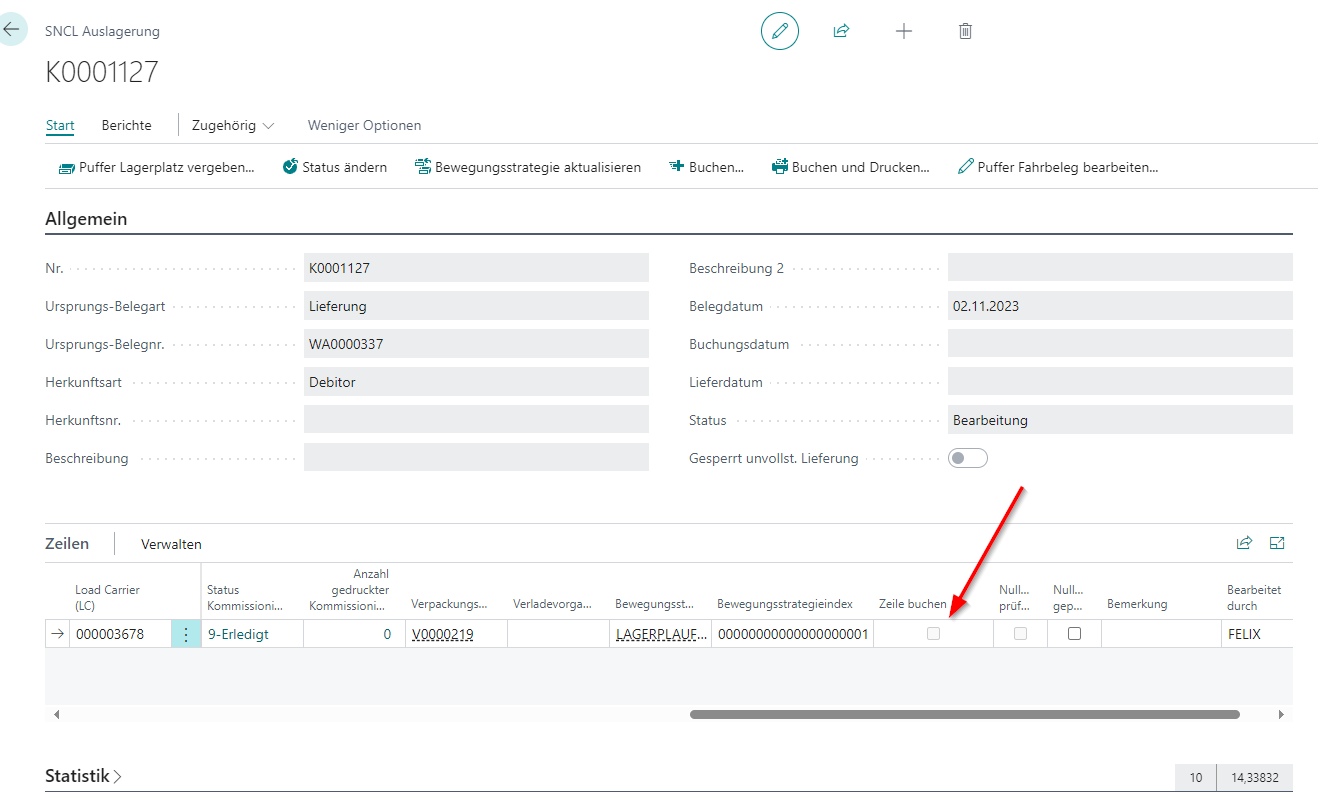
In exceptional cases, new items may need to be added to the picking document during the Response or in the packaging processes. Proceed as follows in such a case:
Hinweis
Please note that the weight of the SSCC is automatically removed and must be re-entered. Removing the weight also resets the state to 2-Recorded. Once the weight has been re-entered, the state is changed back to 7-Packed.
Performing a posting or partial posting without loading
As soon as picking is complete, you can carry out a posting or partial posting of the warehouse shipment at any time. The prerequisite for this is that the Loading required indicator is not set for the selected shipping agent. If the indicator is set, you can also carry out partial postings, but only those items that have already been loaded and therefore have the status 9-loaded will be posted. There are various options for postings:
- Posting all items of a document to
- Outbound Stock Post
- Picking
- Packing
- Postings of individual document lines to
- Outbound Stock Post
- Picking
- Packing
Hinweis
With a partial posting, you post part of the warehouse shipment. The rest remains in the warehouse shipment and can be shipped later.
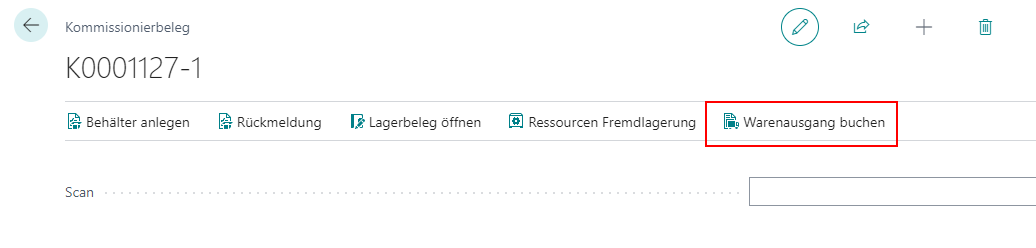

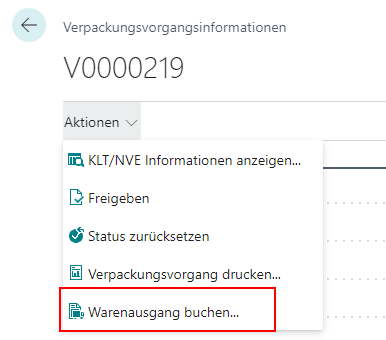
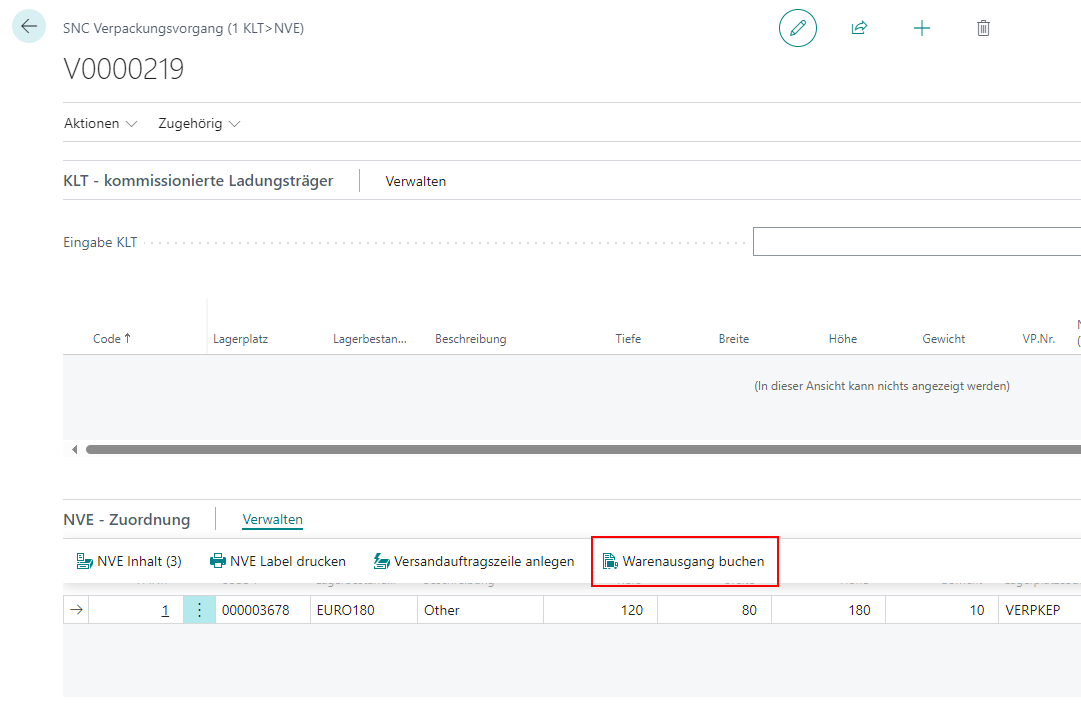
Stocktaking
Hinweis
Please note that stocktaking can no longer be deleted as soon as stocktaking lines have been marked as counted or an assigned open cycle counting list exists.
The goal of stocktaking is to count every active storage place in SIEVERS WMS. A warehouse should count inventory at regular intervals in order to
- meet the requirements of tax authorities and auditors
- identify and correct discrepancies in inventory
- measure the accuracy of the warehouse
Prerequisites for counting a storage place:
- not yet recorded in the stocktaking period
- without PTU and SSCC
- no inventory reserved
The latter is a temporary restriction for technical reasons, which will be removed in the medium term.
Hinweis
Stocktaking of blocked inventory: By default, blocked inventory cannot be counted. In the SWMS Setup in the Stocktaking tab, the check for blocked inventory can be deactivated via the setup field Take Blocked Inventory into Account. If this flag is set, stocktakings for blocked inventory can be created, counted and posted without restrictions.
During stocktaking, an inventory change can also be carried out directly if necessary.
SIEVERS WMS currently supports the following stocktaking types:
- Initial stocktaking
- Permanent stocktaking (Only via SIEVERS WMS Mobile)
- Annual stocktaking
- Zero stocktaking during picking
- Empty storage place stocktaking
Annual Stocktaking
Annual stocktaking can be processed document-oriented or without documents. A prerequisite for annual stocktaking is that all processes that do not belong to stocktaking are completely stopped. Only stocktaking can be carried out in the designated area. The designated area can be specific shelf rows, levels or halls. Or even the entire warehouse.
Preparation
Before the actual annual stocktaking, some preparations should be made:
- Prepare the storage place inventory. For example, ensure that all inventory is marked with labels. All PTUs and SSCCs should be separate from the storage units.
- Divide the employees into small stocktaking teams, for example two people: a counter and a recorder. Assign these teams to the areas designated for stocktaking. Ideally, the areas and teams are prepared so that the areas can be counted in a maximum of 3 hours
- Ensure that there are no open inbound stock posts, outbound stock posts or move jobs. There must be no more reservations as soon as stocktaking starts.
Create and fill in the necessary stocktaking documents for the preparations. A separate document is created for each stocktaking team and area. This facilitates overview and transparency. In the stocktaking documents, you can start assigning the areas. To do this, click on Enter inventory by storage place or Enter inventory by item.
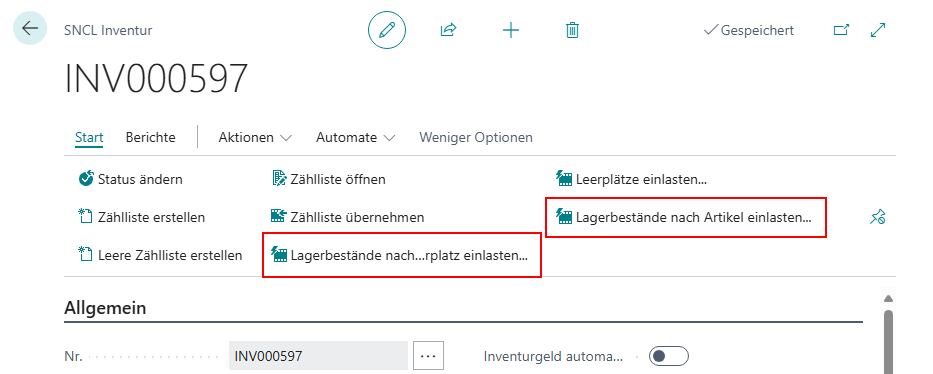
Here you can use various parameters to determine exactly which storage places should be included.
Implementation
Stocktaking MDE
Stocktaking on the MDE device is described in the section Using the MDE device/B5 Stocktaking.
Add new Inventory during a stocktaking
It can happen that during a count it is discovered that there is an unforeseen amount of Inventory in a storage place. You can also add this inventory during the count. On the MDE device, use B5.5 New Inventory for this. Continue with the following section.
Hinweis
Please note that new inventory found that exceeds the set threshold values is automatically transferred to the second cycle counting list.
Hinweis
Please note that outside storage items can only be entered during an outside storage stocktaking.
With MDE
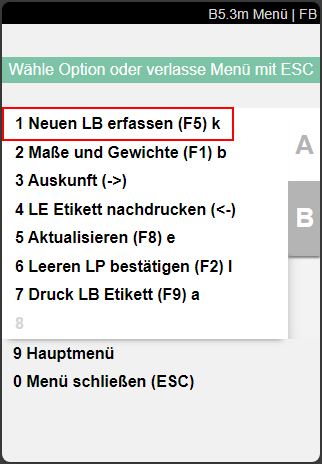
During a stocktaking, you can add new Inventory in B5.3 by pressing F5 or via the menu B5.5.
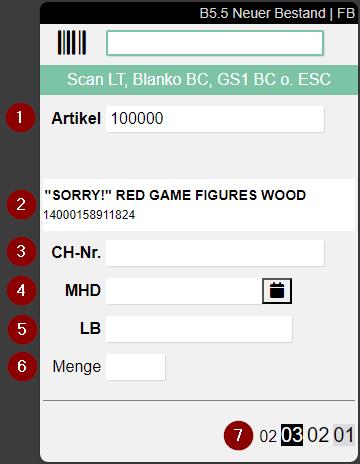
- Scan the item you have just found (1)
- Scan a Blanco Barcode for a new load carrier or scan an existing load carrier (can also be archived)
- Enter any required fields such as sell-by date or variant (4)
- Enter a quantity (6)
- Confirm the entry with Enter
- Scan another position or exit B5.5 by pressing Escape twice
(2) is the current storage place.
Depending on which fields are required according to the item properties, these are also shown.
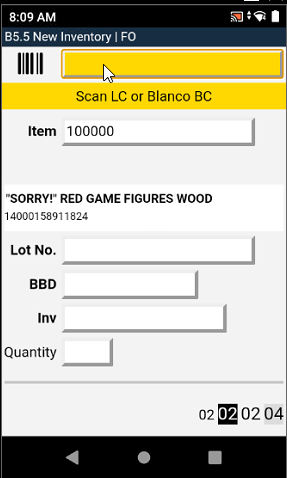
In a document-oriented stocktaking
In a cycle counting list, you can open the New inventory window via Start.
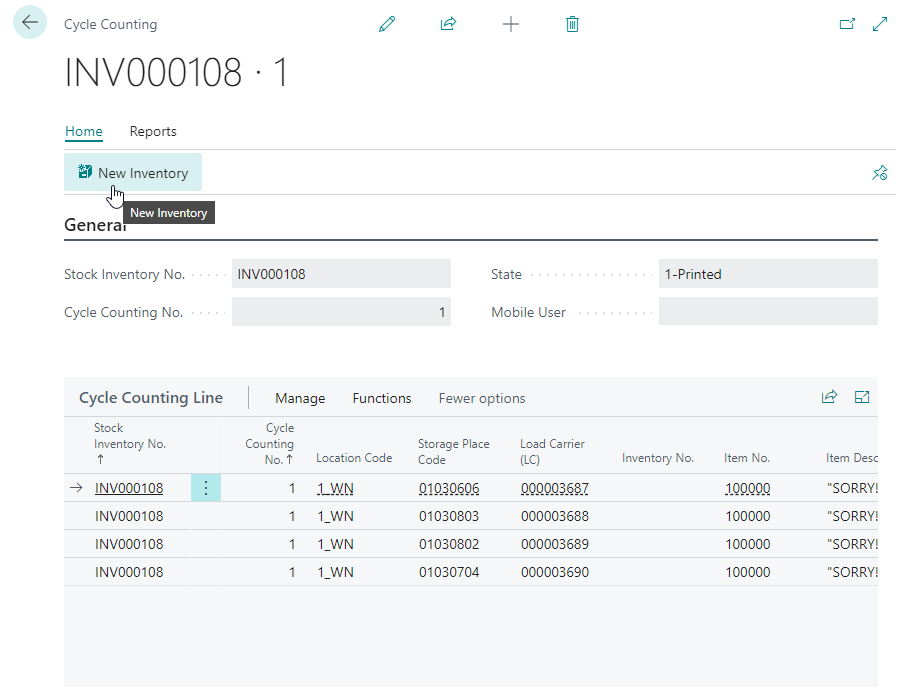
There you can add new inventory in the New Inventory Stocktaking window.
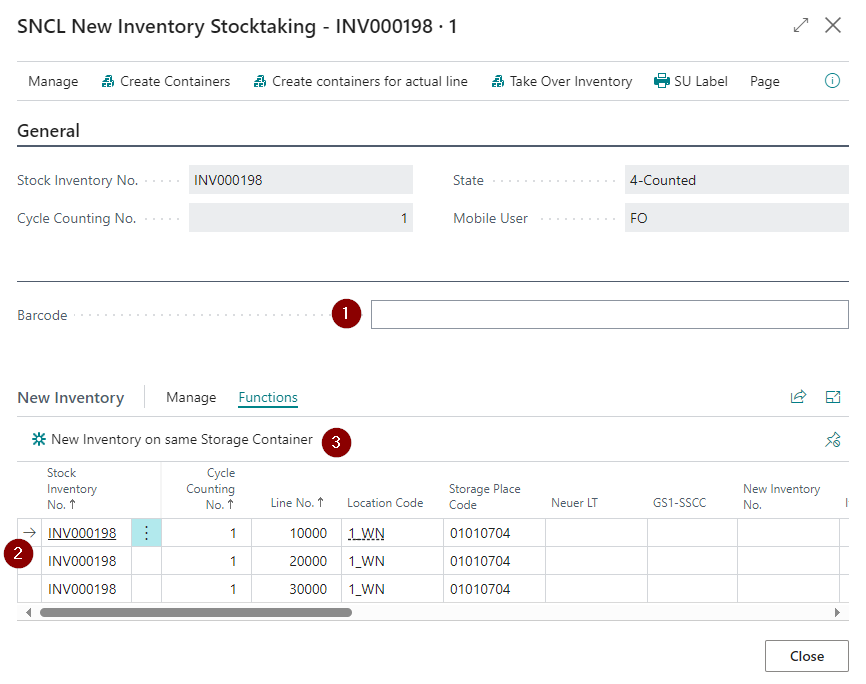
- Scan item/Load Carrier
- Enter additional information such as the quantity. If the item has variants, a variant must be entered.
- If you want to add new inventory on the same storage Load Carrier use the respective function
You can also use this method to enter incorrectly stored stock in the correct place.
In addition, you can also create new Load Carriers via the menu actions without having a blanco barcode.
Outside Storage
The processes in the context of outside storage differ only slightly from the normal processes in SIEVERS WMS. Nevertheless, there are differences that are highlighted in the following sections.
Warehouse Receipt in outside storage
Hinweis
Please note that resources can still be entered manually in the lines of the SNCL Inbound Stock Post order even after release.
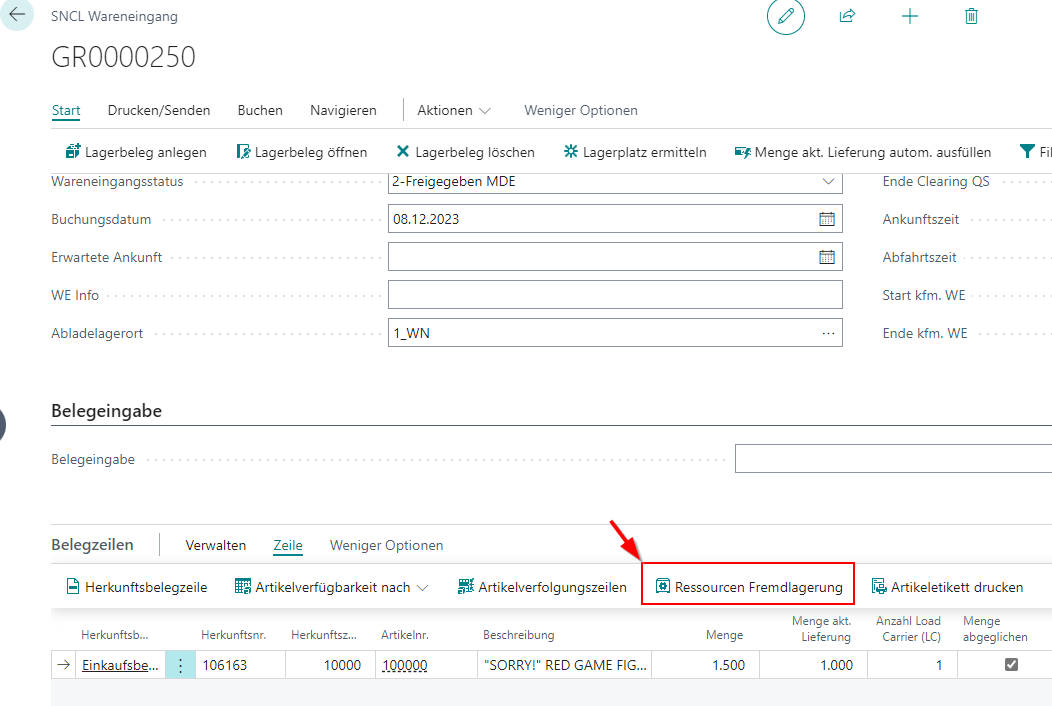
x. In SNCL warehouse receipt you can now create an SNCL Inbound Stock Post with Start -> Create stock document. x. Now you can continue with the warehouse receipt as normal: Processes: warehouse receipt. To enter outside storage resources sporadically, use the Outside storage resources function in the line menu of the receipt lines in the warehouse receipt or directly in the Inbound Stock Post.
Warehouse shipment in outside storage
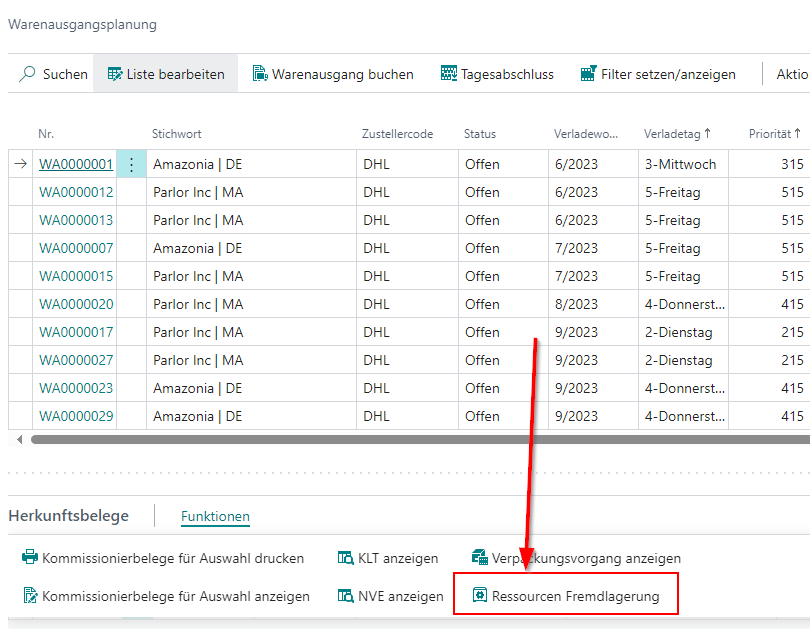
x. You can now create a warehouse shipment from this Outbound Stock Post order. x. In Warehouse Shipment Planning, you can now create an SNCL Outbound Stock Post with Start -> Create stock document. x. You can now continue with Warehouse Shipment Planning as normal: Creation and progress of the warehouse shipment document and picking document. For the sporadic entry of outside storage resources, use the Outside storage resources function at various points in the process if required:
- in the source document functions in Warehouse Shipment Planning or the Warehouse Shipment content,
- in the line actions at item level or
- in the picking document
Dealing with resource recording in outside storage
The resources in the context of outside storage are used to record expenses. These can be regular expenses such as the use of materials and personnel for a warehouse receipt or irregular expenses such as the additional securing of poorly packaged items. You can record regular or recurring expenses largely automatically. You can record non-recurring expenses manually during the progress of external warehouse processes. Outside stock resources are billed using the outside stock unit billing.
Resources for recurring expenses
You can automate the utilization of resources. We recommend setting this up for recurring expenses. To do this, activate the Enter * Charges automatically options in the SIEVERS WMS setup. If you do not want to activate this in principle, you can also activate these options manually for specific customers and vendors in the respective cards in the SIEVERS WMS area.
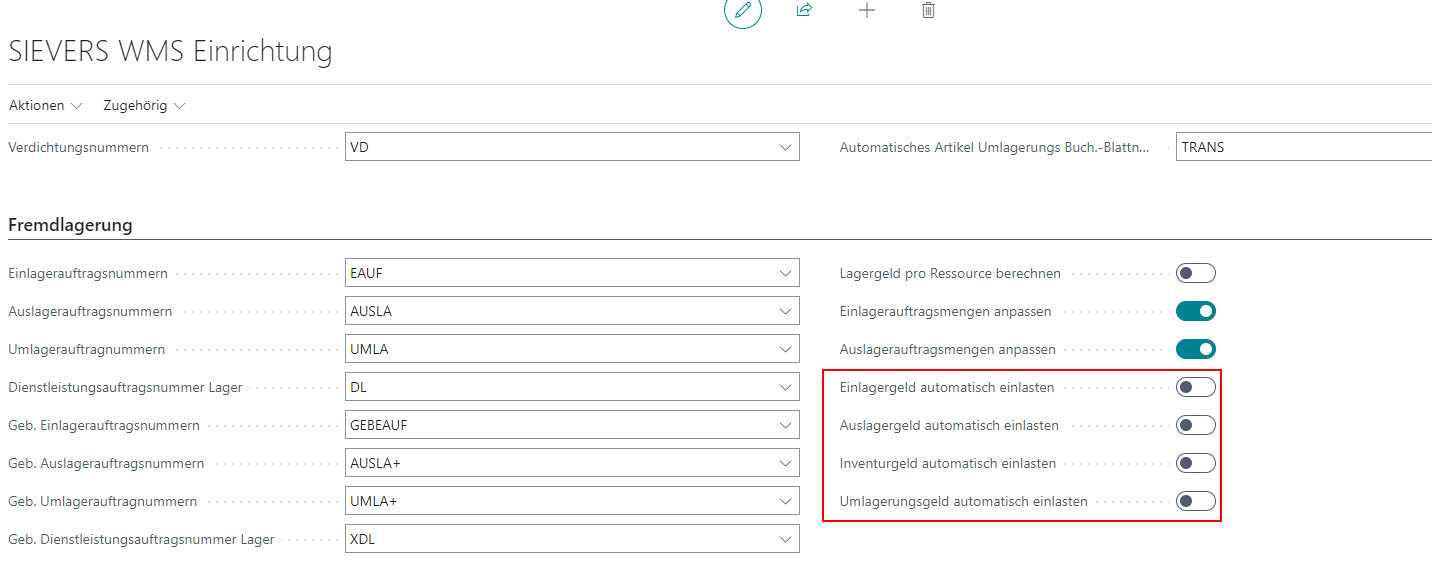
Now store the appropriate storage charges codes in the item or in the customer.
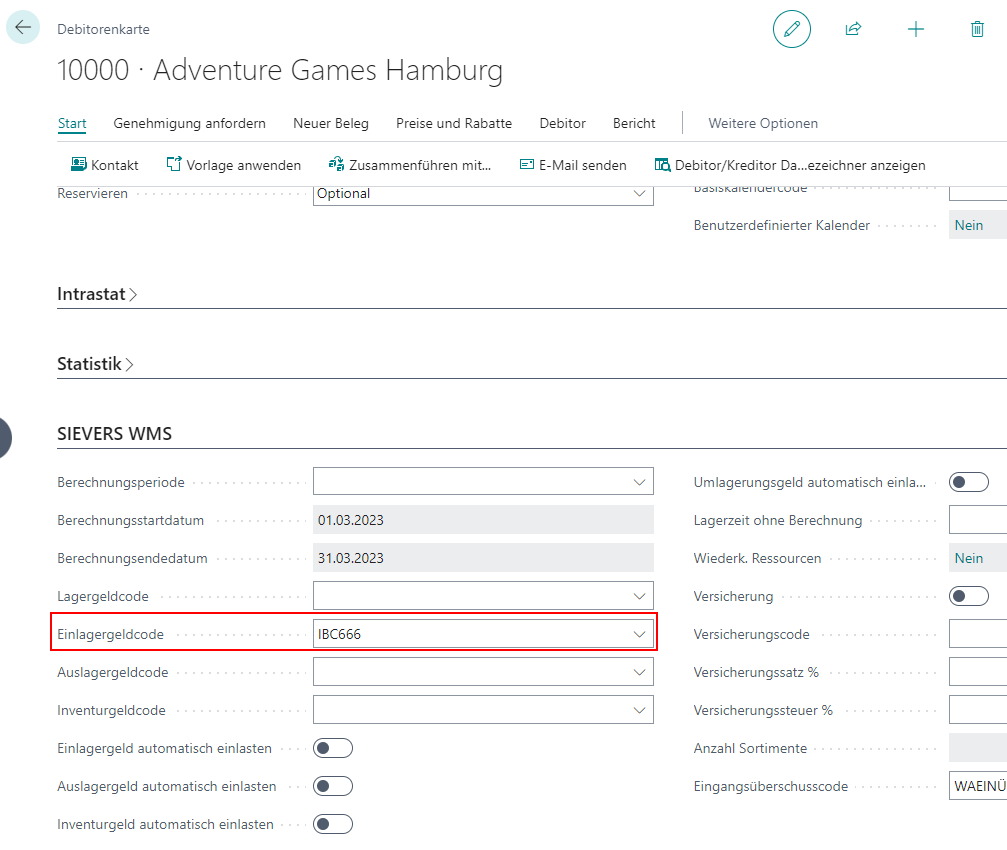
These resources are now automatically entered in the receipt lines after posting the document. In the case of stocktaking, the expenses are automatically entered in the service order warehouse. If you do not want the resources to be entered automatically, this can also be done manually for each document. To do this, execute the Enter Inbound Stock Post/Outbound Stock Post charges action after releasing the document.
Assembly
Assembly is a process from the Business Central standard that has been slightly expanded with functions from SIEVERS WMS. For example, it is also possible to perform assembly for an outside storage customer.
Hinweis
Please note that assembly is intended for “simple” compositions with fewer components. Advanced complexity is not possible here. In such cases, use Production. If you are unsure, please contact your contact person at the SIEVERS-GROUP.
To create an Assembly Header, you must first fill in the assembly parts list for an item. To do this, open the item card and scroll to the Procurement section. If you click on No or Yes under Assembly parts list, a list will open.
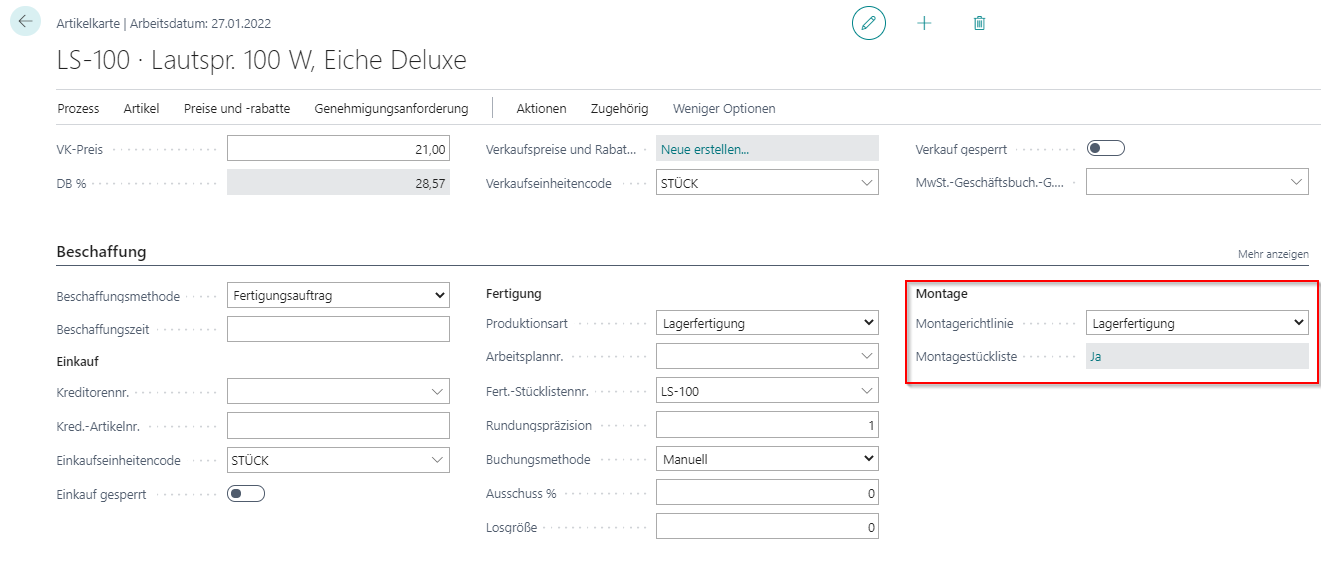
Enter the components required to assemble the item here.
Hinweis
Please note that only items with the same Inbound Stock Post Customer No. can be entered in the parts list in outside storage (Inbound Stock Post Customer No. stored in the item).
You can then create the first Assembly Order for the assembly of this item.
- Open the Assembly Order page and select an item with an assembly parts list. Make sure beforehand that the components required for assembly are available in the SIEVERS WMS-managed location.
- When the item is entered, the assembly order lines should be automatically filled with the items from the assembly parts list.
- When the Assembly Order has been completed, release it.
- Under Home you can now create a component stock document (stock document comp.) and a stock document. The stock document is the Inbound Stock Post document for the fully assembled item. The stock document comp. is the Outbound Stock Post document for the components.
- Assign a storage place to the items in the stock documents automatically or manually and report the documents ready via Change state.
- You can now simply post the assembly order. This posts the Outbound Stock Post document for the components and removes them from the warehouse. The Inbound Stock Post document adds the finished item to the warehouse. The two stock documents are also finalized after the assembly order has been completed.
You can always view the current state of the stock documents in the lower area of the assembly order.
Production
Carrying out production
Production is a process from the Business Central standard and is used to assemble products in several work steps across multiple machine centers. It is therefore designed for more complex production than assembly. This process description describes a viable production process. Please note that the procedure in your company may be different.
Hinweis
For production, the user experience must be set to Premium in the company information. This requires a separate license. Please ensure that you have this license.
Production planning, control, and monitoring are carried out centrally via the production order.
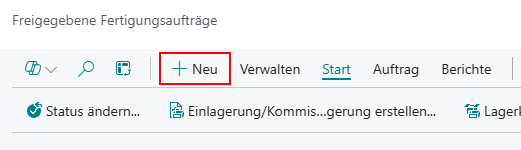
- Create a new Released production order. It is also possible to create a Planned production order, but we believe this is an unnecessary additional step, as a released order is generated anyway when the scheduled production order is released. However, if this is helpful in your process, you can of course still create a scheduled production order. The procedure is the same.
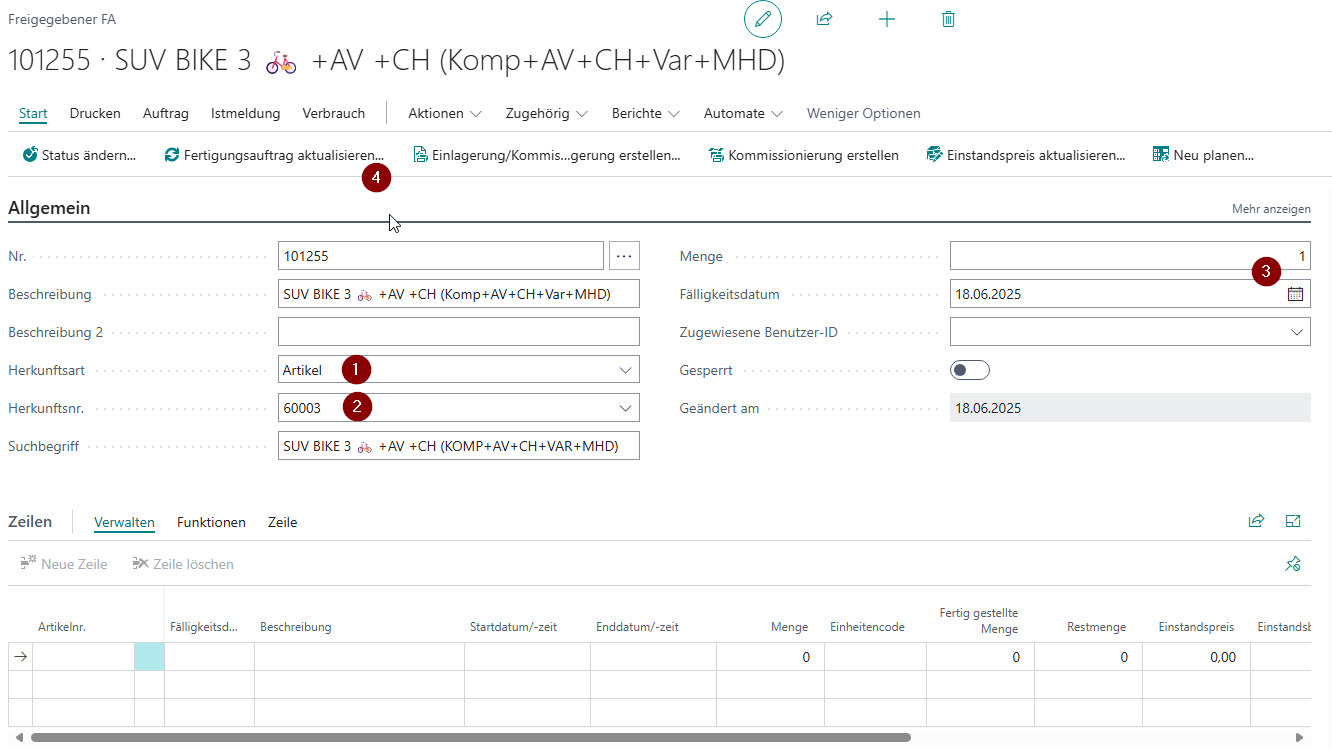
- In the production order header, select the source type. For example, if you want to start production based on a specific item, select Sales header and then the source no., quantity, and due date. Make sure that the item is suitable for production. You can see this, for example, if the procurement method for the item is set to Production order and the production type is set to Make-to-order or Make-to-stock. In addition, a production bill of materials should exist.
- Click Refresh production order to automatically fill the lines of the order. Leave the settings here as they are.
- At least one new order line should now appear. If you select this line and access the Component list via Line -> Components, you can ensure that the correct components in the required quantities from the correct storage place are assigned to this item.
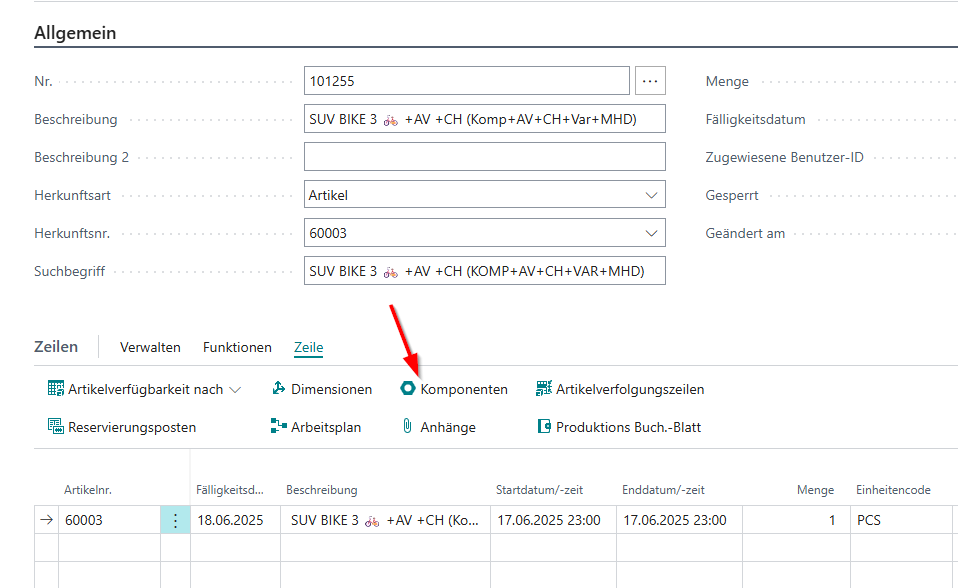
- Also make sure that the Production replenishment is saved.
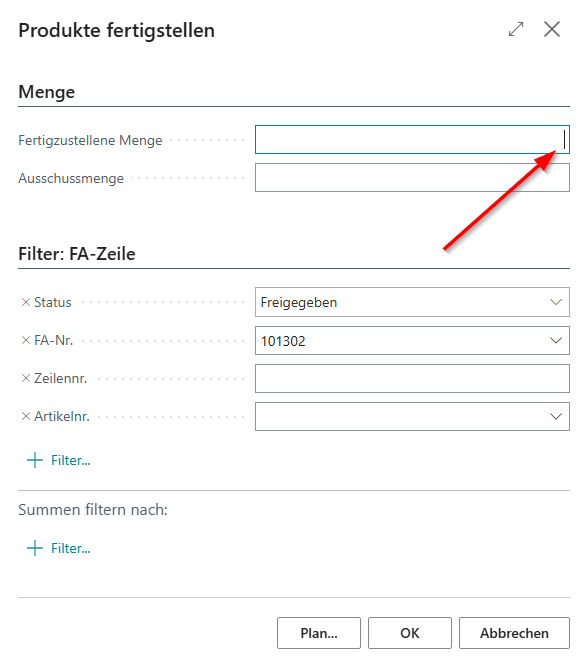
- You can now finish the products via Order -> Finish Product. This action combines the output journal and the consumption report. Enter the quantity to be finished and confirm with OK.
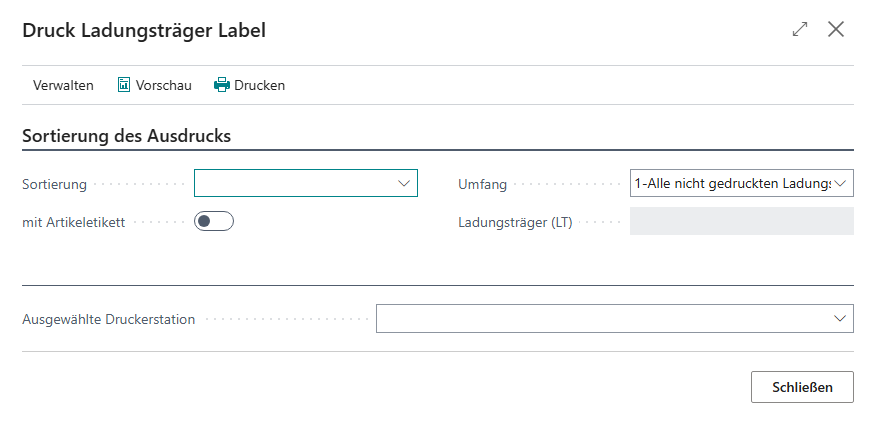
- Finally, you will be asked to create load carrier labels for the load carriers of the newly deposited products. The carrier type depends on the setup Create Warehouse and Stock Document on Output in the SIEVERS WMS setup:
- Setup active: The inventory is deposited on a PTU/SSCC, as a warehouse shipment and stock document are automatically generated
- Setup inactive: The inventory is deposited on an SU (Storage Unit)
- Production is now complete.
Replenishment for production order
Production must also be adequately supplied with replenishment. This replenishment delivery is carried out by the production supply, which can be automated via a job queue or carried out manually. This description deals with the manual form of replenishment creation.
Replenishment is calculated based on the Quantity determination basis manuf. field in the Check production supply action. Here you can specify whether the requirement should be generated based on production, the items, or both. In the first case, replenishment is only generated when a specific requirement can be derived from an order. For requirements from the Item, the Production quantity specifications fields are used.
- You generate replenishment for production orders via Check production supply. You can find this action as a separate task via Business Central Search, but also in the Released Production Orders. Explanations of the fields can be found in the corresponding section linked above. For now, select the Details option.
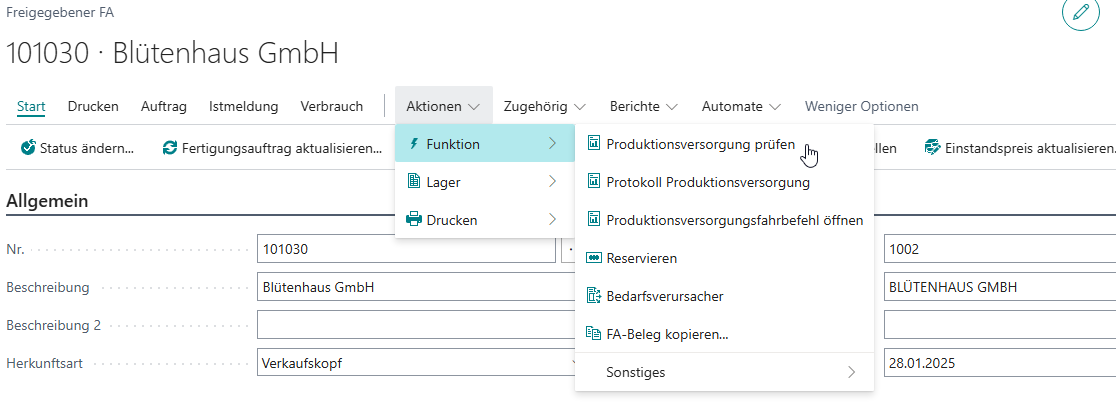
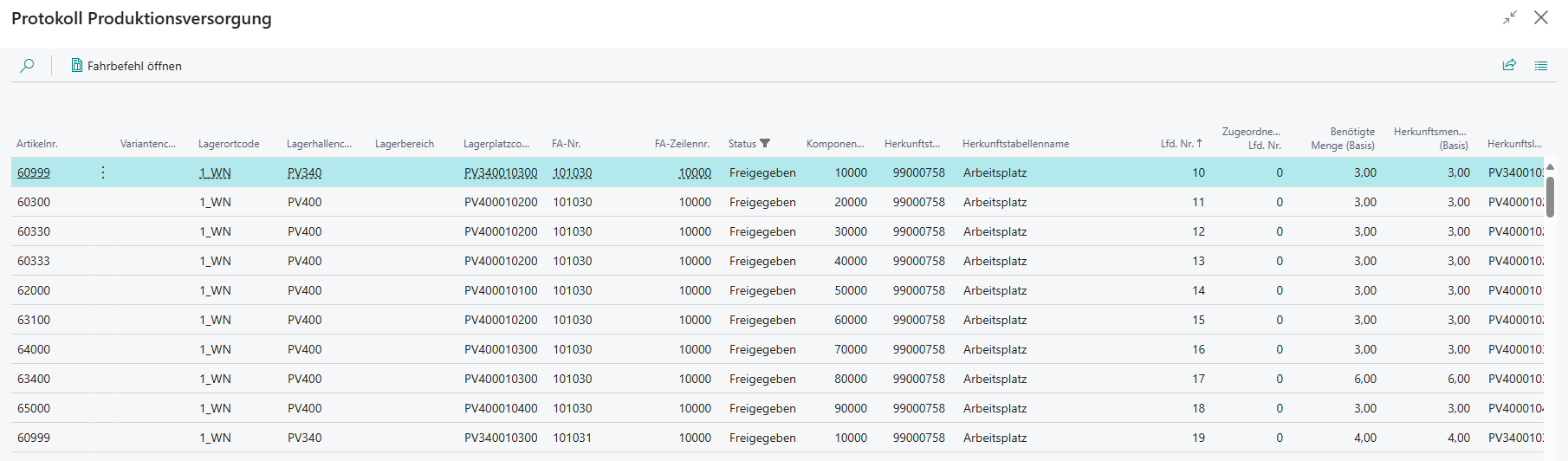
- If necessary replenishments are identified, the system creates replenishment move orders. A move job line is created for each component it finds. The number and composition of the move jobs depends on the selected grouping. See Check replenishment production places. If you have selected Details, the Production Supply Log opens automatically. Here you can now see which move orders have been created. You can monitor the progress of replenishment at any time via the Replenishment Status field:
- In the production order component lines you can see the status per component
- In the Released Production Order (header and lines) you can see the aggregated status
- In the list of Released Production Orders you can see at a glance which orders are ready on the supply side
- Depending on the setup, the move order created can then be executed with MDE C1 and C2 or document-oriented using the move order list printed on the move order.